


Previous Story
VamoStraying: ReVive La Difference+
Posted On 20 Jan 2024
Comment: 0
Post-COVIDic Hodophobia ➬ Toward Traveler ReMotion (Premise).
re: Digesting Travel’s Latest In-or-Out Burgers: e.g. Duffy, D.O.T. ↓
Close, But No Closure.
(7/31/25+)—Close, but no Mylar, no PVC body bags, no flower/candle mourning, not this time, anyway…
Otherwise, some instances are too close to call nowadays. The most recent among them: Delta Airlines Flight DL56, bound from Salt Lake City to Amsterdam July 23, hit a SIGMET thunderstorm and severe air turbulence 35,000 feet over Wyoming. The Airbus A330-900 quickly climbed 1,000-feet, then plunged 1,350, emergency landing at Minneapolis-Saint Paul International, whereupon 25 of 275 aboard were taken to hospitals, frightfully shaken and stirred. The hellacious yo-yo tumbler (after a string of similar turbulent flights since 2024) further underscores a seemingly never-ending pattern of close calls and near misses—on airport taxi/runways and aloft.
Heat domes, atmospheric rivers, smokey overcast, power-packed storm fronts, flash flooding, torrential squalls: foul weather and other changing climate-related ‘CanDels’, even system-wide ground stops are intractable factors in today’s crowded air travel skyscape. But the above instances are just a drop in the barf bag…
Fear Jerkers No End?
Since July Fourth week alone, it has been a midsummer of white-knuckle suspense and gut-wrenching suspensions. First the US Independence holiday saw a landing JetBlue airliner veer off an Orlando runway onto the airport’s grassy shoulder. Shortly before, came the fatal, allegedly pilot-caused Air India disaster; this, after a late-June near collision on San Francisco International parallel runways was attributed to ATC tower-cockpit miscommunication.
Specifically, Air Canada Flight 760, an Airbus A220 was cleared for takeoff on runway 1-Right while ATC instructed a United Airlines Flight 1111 wide-body headed for Hawaii to “cross runway 1-Left, cross runway 1-Right”. But then the tower directed yet another UAL jetliner to takeoff position on 1- Right, Air Canada Flt. 760 speeding down that runway as the United plane crossed 1-Left. At least until UAL 1111 reminded the tower it was already holding on 1-Right—oops, whereupon the overworked controller noted, with a terse “UA, um, I told you cross 1-Left, hold short 1-Right..” Oh really? Check the tape…i.e., close call, collision thus averted, thanks to the heedful Flt. 1111 pilot, who aptly held his tongue.
Then came Turkish Airlines Flight TK79, an Airbus A350-941 from Istanbul to SFO, emergency diverting to Chicago O’Hare International with a passenger who had died inflight despite medical treatment and CPR. Add Delta Flight 127, an Airbus A330 headed to JFK from Madrid, diverted to Terceira Island in the Portuguese Azores due to left engine trouble, stranding some 300 passengers for over 30 hours. Or the midair scare wherein a disturbed passenger shoved past crew members to storm an emergency exit door before being tackled by heroic fellow riders—ergo chalk up one more of 871 unruly passenger reports in 2025 thus far.
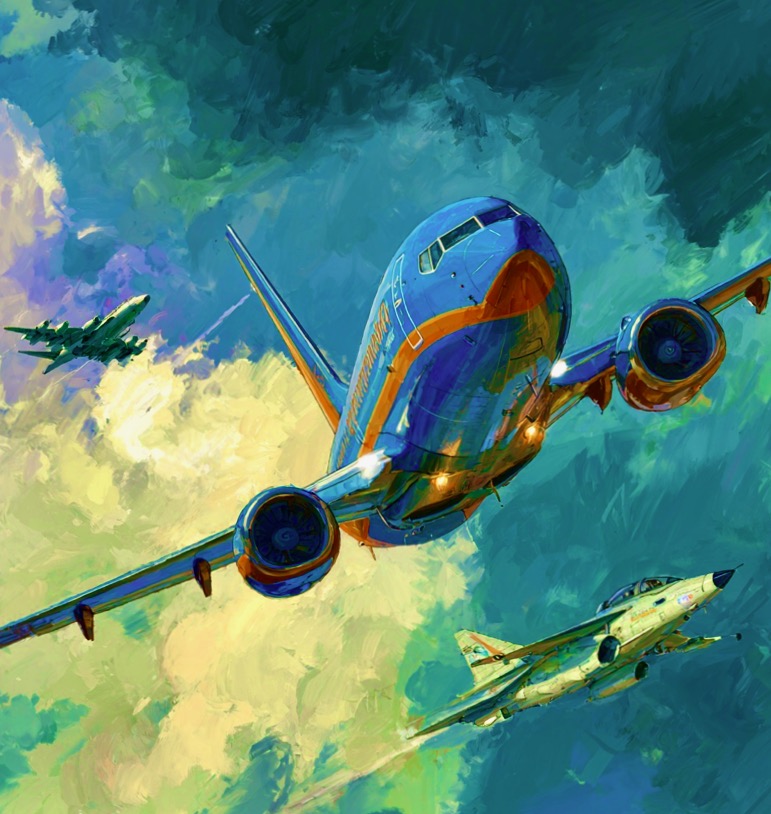
Battling for sky supremacy? Gotta be nobody’s bag anymore…
Also consider various IT/tech outages and mechanical issues, such as on an SFO-bound UAL Flight 949, a 23-year-old 777-200ER with 285 aboard that doubled back to London/ Heathrow from 15,000 feet over the city of Milton Keynes, reportedly with a smoky galley area. Then a system-wide UAL (Unimatic) IT outage, 1,000 flights delayed for some three hours nationally. Much less an Alaska Airlines technology outage that similarly triggered a (3-hour) ground stop systemwide. Soon, an American Airlines’ landing gear fire during takeoff forced the 737 MAX 8 to slam its brakes at 130 mph, returning to the DIA gate, passengers deplaning on emergency slides.
MFOs: Military Flouting Objects?
Engine failures, systemic glitches and tire blow-outs are everyday hazards and headaches (unlike suicidal pilots or a felonious first officer). But speaking of deep dives, call out the military—more specifically some decommissioned combat aircraft. Cases in point: Southwest Airlines Flight 1496, a 737 MAX bound for Las Vegas from Burbank, CA sharply dove from 14,100 to 13,625-feet in 30 seconds not long after takeoff to avoid a British-made Hawker Hunter fighter jet (now privately owned), joyriding without ATC radio guidance or control.
Days before a Delta/SkyWest regional Flight 3788, approaching Minot International Airport from Minneapolis, veered suddenly to dodge a ‘retired’ B-52 Stratofortress overflying a North Dakota State Fair event—that massive bomber having taken off from nearby Minot Air Force Base. The SkyWest Embraer 175 pulled an emergency “go-around” maneuver so as to avoid any possible collision, its pilot noting that the Minot International tower is under private sector ATC, and directs flights visually rather than via standard radar.
🎼 “99.99 and a half just will do…“ 🎸 🎷
Clearly FAA cuts and air traffic control tower/center shortages only exacerbate such fearful safety shortfalls, what with some newbie controllers staffing screens directly out of Oklahoma University. or Tulsa Community College (foregoing the FAA’s ATC Academy in OKC). Add to that route-cramming flights into overcrowded lanes to dodge stormy weather, air traffic congestion, or global conflict zones.
Skimping airlines, stressing staffers—straited, sodden skies: beget near misses and worse that are too close for comfort. It all makes for a stormy hit-or-miss scenario with no reassuring closure in sight. Just the same, Vamigré will keep a keen eye out for signs of clearing. Meantime, see you aboard the other 99.999% of airline flights, which do operate safely and surely everyday. (MTC…)

Summery Judgment: Toward the Better Half.
(7/15/25)—As we summer Fourth into 2025’s second half, how goes it thus far? Too hot, too wet or costly to travel? Au contraire, for one thing: the US Independence Day holiweek proved to be far from a Star-Spangled dud.
Early tourism industry forecasts claiming Travel ’25 would miss 2024’s post-pandemic/revenge heights grossly underestimated the US public’s ongoing itch to roam—whether by land, sea or sky. By the numbers July Fourth travel was actually up 2.4% over ’24, some 72.2m on the move, 6.1m by air alone (the most in 15 years)—with airfares down slightly, fuel ppgs down .37 per on average over last year.
Lagging somewhat has been international travel, likely falling victim to the twists and tensions of TrumpTwo-era trade and tariff tiffs, not to mention travel bans, customs crackdowns and ICE actions. The latest snag: a $150 visa integrity fee, refundable if inbound travelers leave the US within five days. Notably impacted are US-Canadian border crossings (down 14-36%), as overall 2025 visits to the US are down some 12% so far.
At any rate, we’ll see if all these numbers hold up through the summer…
Too Hella By Half?
This, as heat domes overcook the globe, atmospheric rivers and mega-rain stationary fronts flood valleys and coastlines. Drought and lightening/wind storms spark wildfires: EU Mediterranean (Crete, volcanic Mt. Etna) westward to the US Grand Canyon and Golden State hills.
It all wrought havoc on air travel, particularly in the eastern US—flights cancelled or delayed (CanDels) by the thousands, congested highways further throttled due to rickety infrastructural failures. No less packed and captious were airport baggage carousels, final leg/hurdle to the rambling July Fourth holiweek. Regardless, sizzling escapades and celebrations still ruled the days.

Footloose, chill surf and lit fireworks.
Smoother TSAs notwithstanding— despite security checkpoints scanning upwards of 3m passengers per 7/4’s busiest holidays—the federal role in air travel continues to rock and roil. Today’s Department of Transportation presides over ever more FAA staff attrition, DOGEy cutbacks, air traffic control vacancies and early tower or center retirements. T/Two loyalty oaths and union bashing surface amid safety tremors like a fatal D.C chopper collision and Newark airport’s operational chaos ever clouding radar screens, mirroring Heathrow breakdowns in the UK.
Same time come taxiway incursions and runway ‘close calls’ (e.g., with a falling severed wingflap); teeming tarmac turnarounds for power outages and other ‘technical/IT issues’, plus wingtip-to-tail ‘kissing’, often between larger and regional aircraft. Aloft are harsher air turbulence, airliner engine fires, TCAS glitches, cockpit alerts/malfeasance, abrupt pitch maneuvers—steep dives and climbs to avoid midair traffic (with B-52 bombers?) and worse. Add cyber/terror threats, dangerous unruly onboard skirmishes—even a free-riding pigeon flapping wildly about the cabin.
Flying Bind.
Meanwhile airlines large and small persist in trimming schedules and route structures, awaiting overdue delivery of clean, green new airplanes from Airbus and ailing Boeing. Proceeding as well is carrier consolidation: United aligns with JetBlue, Alaska absorbs Hawaiian Air, Alitalia/ITA merges with Lufthansa. Terminally, UAL battles American Airlines for hub supremacy at Chicago’s O’Hare Airport, and San Francisco International spars with rival Oakland for Bay Area dominance and naming rights.
Trendwise, legacy carriers such as Delta and United are openly skewing toward more upscale passengers, aiming for the premium business travelers increasingly boarding (and/or sharing) private jets. Even Southwest Air focuses on new, tighter tix/resv, seating and bag rules that would probably have co-founder, Herb Kelleher pacing, fuming in the aisles.
On the low-fare end, Allegiant, Frontier and Spirit sputter financially, Avelo selling out to ICE deportation flights—while Ryanair and Whizz scale back some across the EU. Then again, newbies like EVA and Volaris take off in fits and starts—all of which underscores how turbulent and high/low rolling the industry is over time. Not that driving, rail and cruising are any less risky alternatives.
Safety Squeeze.
Now, where does that leave us? Beyond the airlines’ casino crapshoot, we travelers face online scams, endless CanDels, combative fellow passengers (pre-to-inflight), ill-tempered if not tormented and overworked crews, seat/overhead territorial tussles, jarring air turbulence, emergency medical issues.
Factor in midair wrestling matches between fighting unrulies and swooping do-gooders, if not manic door chargers trying to bust out through emergency exits at 30,000 feet. Let alone terminal hustlers, street crime, drive-by killers and crazy lone-wolf weapons cachers with death wishes, and myriad shark attacks once we get there.
Welcome to the New Subnormal.
So let’s be real. Vamigré is not talking fetal, couch-spud surrender these midsummer days, but better, keener preparedness. Shrewdly readying for vehicle parking/rental strains, airport shakedowns and ground stops, carry-on/luggage disputes, seat mis-assignments, inflight row pressures, leaky cabins, lumpy cushions, spotty media/WIFI, lithium battery flareups and pushy tray-table discord.
We’ll tool up and parse traveling on better days than during rush crunches; flying solo versus with pets; sleeping more soundly onboard (though remaining mindful of grabby, groping neighbors); going green and healthy as can be. Welcoming even not-so-welcoming destinations: the likes of Barcelona, Venice, Amsterdam. Visiting well-paved paths or lesser trod park places—lodging, BnBing smartly and safely— focusing more on ‘elsies’ than selfies, body clocking jet lag, whatever the zone.

Savvier goalpost: Too schooled and tooled to be fooled…
In all, by packing simply or cannily luxe, whether boarding via attimood or mode: plane, train, roadway or by ferry/open sea. Overcoming the mega-tourism blitzes, the skittish weather or whether’s, overbooking bumps and grinds, inevitable TSA checkpoint slogs, line jumpers and gate ‘lice’, or the borderline red-tape madness worldwide.
This means telling it like is in the second half, kicking into a higher gear with our travelin’ shoes fit and firmly worn—seeing the light, yet keeping it lite. Seeking out the ‘other’, brooking neither militantly radical globalists nor smugly Americans—being less a sentry point than a scouting post about it all.
Which is to say curveting the hurdles and clearing the air as we travelers make our way from doom-scrolling to dream-strolling toward a Vamostellar midsummer. And to be sure, that ain’t the half of it, wherever, however we may go… (MTC…)
Terminal Shoephoria?
(7/11/25)—Shoe loose and footsie free at last? Well, time will tell, as no less than the US Transportation Security Agency has finally waved shoe-fly bye to the foot-hoppin’, boot-yankin’, sandal-snappin’, sock-rippin’, toe-jammin’, sole-stinkin’, counter-crushing airport checkpoint drill.

Feelin’ friskier sans the foot-long frisking.
Shoe Bombers at Heel.
The entire off-putting shoe removal routine took foot back in 2006, after an apparent 2001 inflight bomb attempt by Richard Reid, a jihadi heel-striker, to set off explosives hidden in his oxfords. Travelers had since been required to doff footwear prior to boarding commercial airliners, so that TSA screeners could swab shoes, boots and sandals for traces of any such explosives.
This mandatory shoe-down smelled of intrusive, impeding overkill from the get-go, particularly during hectic, teeming terminal periods. So be it, slow-but-sure ruled the day at airports across the land. Children and elderly passengers excepted, the only effective ‘walk around’ tactic was enrolling in the TSA’s PreCheck program, essentially paying handsomely to shoehorn right through security lines.
Shoe-Yank Redemption.
With this latest ‘common sense’ move, however, the rest of us can now keep our shoes on, as well. TSA’s stated goal is to better ‘streamline’ and otherwise grease the checkpoint skids in major airports—and other airports before long—given that air travel traffic snarls are escalating, day by holiday. Although that is likely little consolation to PreCheck members who suddenly lose their key PC advantage.
Nevertheless there will be no screener flagging of flag-raising travelers whose footwear triggers full-body magnetometer alarms, for they will still be subject to the usual shoe removal, wanding and patdown rigamarole.
‘Smoother while safer’ as technology advances allow: That’s how is Homeland Security Secretary Kristi Noem puts the shoe ruling, adding that further regulatory easing could address carry-on laptops, liquids, belts and certain outerwear.
In any event, Vamigré will be warily waiting for the next TSA shoe to drop. Humming ‘Foot stompin’, foot stompin’, foot stommmpin’ as we keep on keepin’ on along the way… (MTC…)
Spydery Infiltration.
(6/30/25)—Oh, what a web they weave—they being an infamous yet faceless network of cyberpunkian hackers that threaten to heave digital firecrackers into this already explosive holiday week, which looks to be the busiest July Fourth in 15 years.
The FBI and various cybersecurity experts finger the “Scattered Spyder” cybercriminal gang, which has been keying on the aviation industry these past two months, after pulling ransomware heists in the insurance and retail sectors (particularly in the United Kingdom).
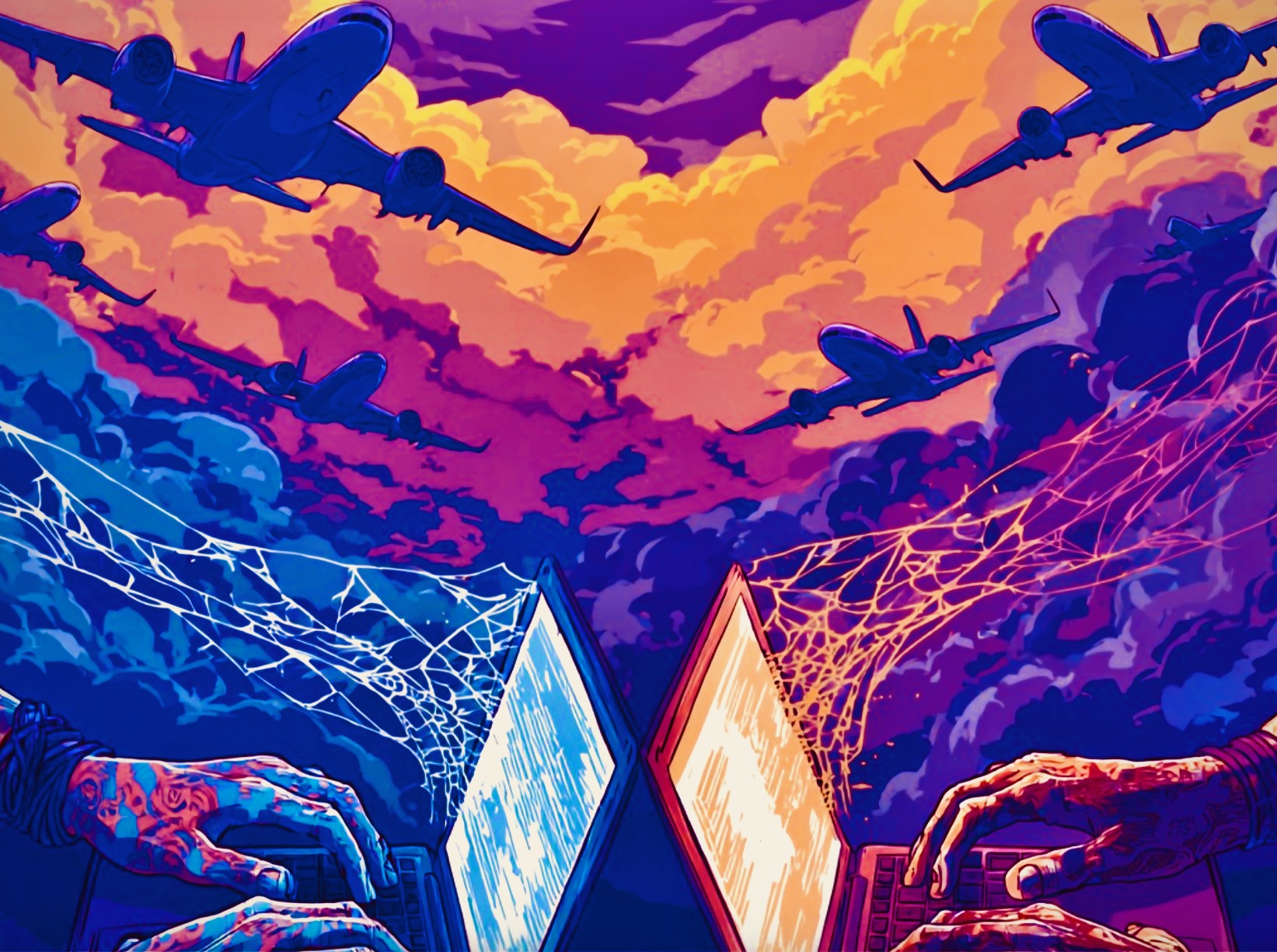
Holiday independence or hack-kneed interference?
Hawaiian Air and Canada’s WestJet are already sifting through their IT wreckage after recent hack ‘n’ sack attacks, with other carriers likely to report in kind before long.
Fortunately internal cybersecurity efforts appear to have essentially staved off such hacking disruption to actual airline operations; threats to air travel safety have not surfaced to date. Still, American Airlines has just revealed its own IT outage—albeit not necessarily code busted at next-gen Spyderly hands—glitches terminally grounding a number of American Air passengers.
So as we go Fourth on this sparkling holiday weekend, best to mind our devices, beware the Spyder web infiltration, otherwise brace for all manner of Scattered cyber fireworks—money-grubbing to geopolitical in purpose and/or motive. Heads up and step wisely along, the Vamigré way… (MTC…)
A Dreamer In Decline.
(6/15/25+)—Just when Boeing’s skies appeared to be clearing, along lands a hazy, fatal fireball of a Dreamliner nightmare: one being deemed the worst commercial airline disaster this century thus far. (Update 7/12)—A Creep at the Switches? Spoiler alert: looks like the captain may have done it. (MTC…)
Air India Flight A1171, a 787 Dreamliner carrying 242 passengers and crew bound for London’s Gatwick Airport, crashed moments after takeoff June 12 from Ahmedabad’s Sandar Vallabhbhal Patel International Airport. All but a lone male passenger perished in the fiery wreckage, which was fed by 33,000 gallons of fuel in the jet’s wings.
Dreamscraping Downer.
Reports are the Air India captain had sent a Mayday message minutes before ruination. Gauzy video footage shows the 12-year-old 787-8 suddenly descending (with a loud noise?) from barely 650′ of altitude, only :30 after 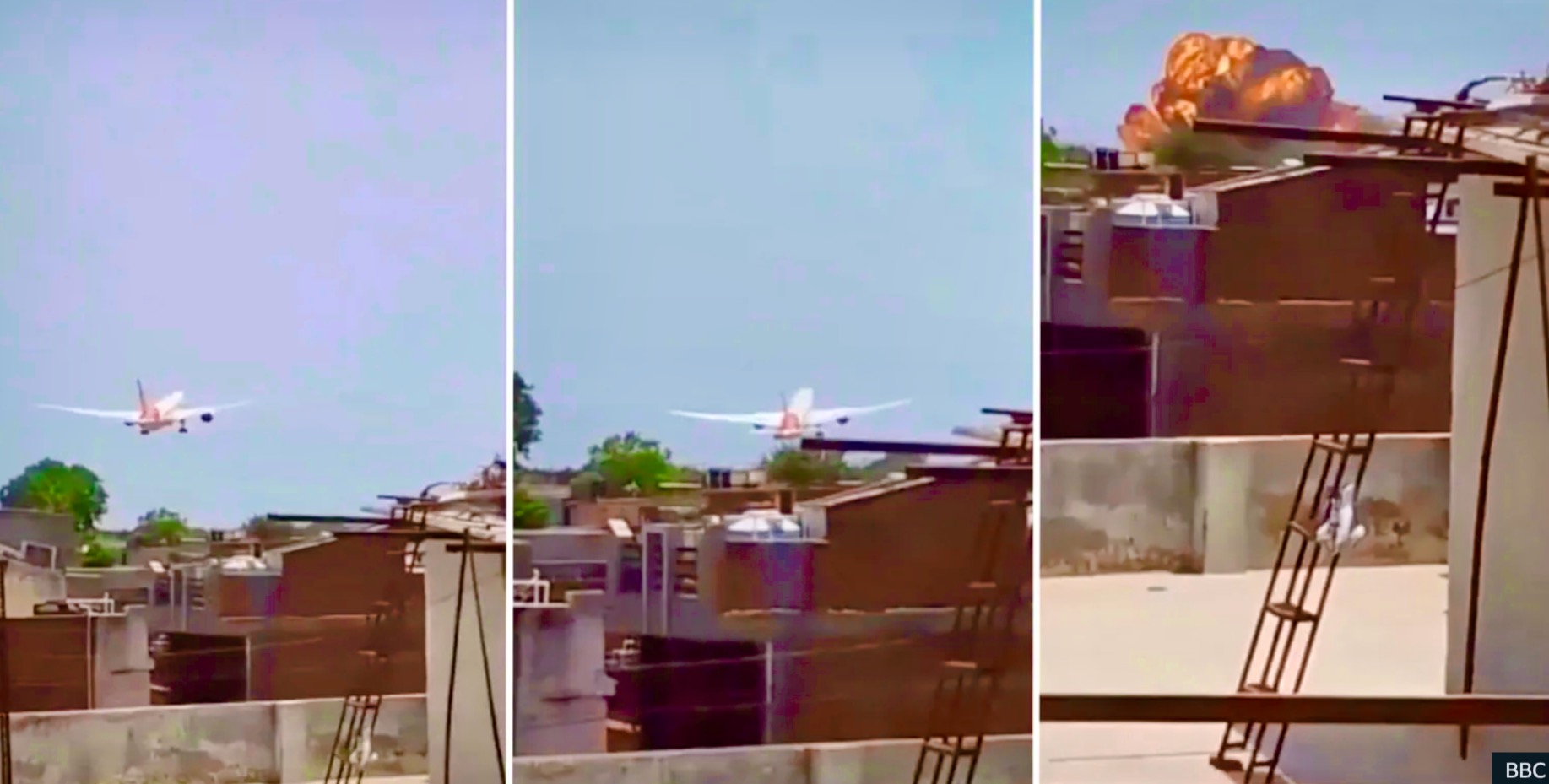 liftoff—dropping like a wounded condor less than two miles out from the airport. The Dreamliner then plowed, horridly raked into a crowded medical school hostel on Ahmedabad’s northwest side, killing dozens of lunching students (+ some doctors) amid searing, billowing black smoke.
Flight A1171’s manifest listed 169 Indian nationals (including a former Chief Minister), 53 Britons, seven Portuguese and one Canadian. Their bodies 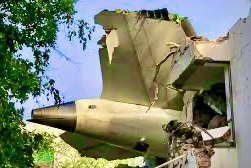 were charred beyond recognition—yet that lone survivor miraculously managed to stagger out of an emergency row seat 11A (having “no idea how”), escaping with relatively minor injuries.
This was the first fatal accident involving the twin-engine, wide-body Dreamliner, Boeing’s recently best-selling jetliner, owing largely to its fuel saving (though sometimes fitful) carbon composite frame, enlarged windows and more spacious overhead bins. Introduced in 2009, more than 1,200 787s have been delivered to airlines worldwide, some 1,100 remaining in service today. Air India purchased A1171’s specific iteration in 2014, one of the first tranches rolling off Boeing assembly lines back then.
Indian Reservations.
At any rate, that oatmealy video release has prompted several operational questions. Why, for instance had the plane’s landing gear not yet been retracted, particularly while its nose was still pointed upward during descent? Moreover, was this a matter of pilot error, engine/thrust failure, manufacturing defects, shoddy maintenance or even bird strikes? 
The US NTSB and Boeing Company swiftly joined India’s Aviation Authorities to investigate the crash—A1171’s ‘black boxes’ since being retrieved. Nevertheless, definite causal answers to the vast country’s deadliest aviation accident in 30 years may be months in discovery. Meanwhile all India’s 787-8/9s with GEnx (and LEAP?) engines have been grounded by aviation regulators for further scrutiny. Initial probes consider whether A1171’s backup ram air turbine (RAT) generator had been deployed due to power, engine or flight control system failure.
Mighty Tatas.
Air India CEO, Campbell Wilson has announced that the owner Tata Group will pay upwards of $117k to each victim’s survivors. J.R.D. Tata founded Air India in 1932, but the carrier was nationalized in 1953, yielding some 70 years of management and financial failures. Mega-giant Tata Group re-privatized the tattered flagship airline for some $350m in 2022, aiming to  rebuild with 191 aircraft, wide-body and narrow—570 more on order from Boeing and Airbus. Air India currently serves 41 international and 43 domestic destinations (the latter routes claiming a 91% share, via budget AI Express and IndiGo as well).
Just the same, Air India, one of the world’s oldest airlines, continues to struggle with cabin and service quality—schedule/on-time reliability to sore seats to faulty toilets—while more premium rivals like Emirates and Qatar Airways poach its customers away.
Moreover, other aircraft incidents soon followed: Air India Flight Ah80–a Boeing 777-200LR headed for Mumbai from San Francisco was evacuated in Kolkata with a left-engine problem. Then a New Delhi-bound Air India plane returned to Hong Kong with a technical issue shortly after takeoff. Precautionary checks further triggered flight cancellations due to ‘unavailability of aircraft.’
As for the beleaguered Boeing Company, yet another gut-punch as it seeks to regain it former gold winged glory. Then again, news also comes of JetBlue Flight 312, which landed at Boston’s Logan International Airport from Chicago’s O’Hare, rolling off the runway onto a grassy border, triggering a full-on emergency ground stop—courtesy of an Airbus A220 this time. No dreamin’ there… (MTC…)
Spring ’25: Coiled, Yet Creaky.
(4/24/25+)— It’s vernal go-time, alright—only to what, where, when, and how? And although the world may beckon anew, will duty battles call BS on travel near and far? So do we stay put high and dry, or sally forth with élan? Alas, considering such wormy word salads and uncertainty raining down these days…
Point being, after super surging travel seasons in 2023/24, what wasn’t to like prospects for Spring/Summer 2025? For example, the airline industry projected another stellar year with rising fares early on. It generally expected no more than a minor inflationary dent in air travel demand, with a new presidential administration promising to end pesky price spikes on day one, at that.
But come January 20, TrumpTwo arrived with some new tariffs and testiness in town—not to mention an untested, family-first and foremost transportation secretary. So before long the airlines were trimming their ’25 outlooks, citing market precariousness owing to fluctuating tariff warfare against the world at large. Whereby US feds were fixin’ to rain punitive levies down on targeted nations, which threatened retaliatory duty barriers of their own.
By now a suddenly worsening inflation rate and shaky economic conditions, plus massive DOGEy chainsaw job massacres, have recessionary probability pegged at 45%—slower US growth potential, if not a recession alarming even the Federal Reserve Board.
Complicating issues include border/immigration disputes with neighboring Canada and Mexico, much less resource-targeted Greenland. Canadian tourism to the US may thus drop at least 20% as Canucks sell off their Florida vacation properties and shout down America’s National Anthem. Then there are TrumpTwo threats to reinstate travel bans first slapped on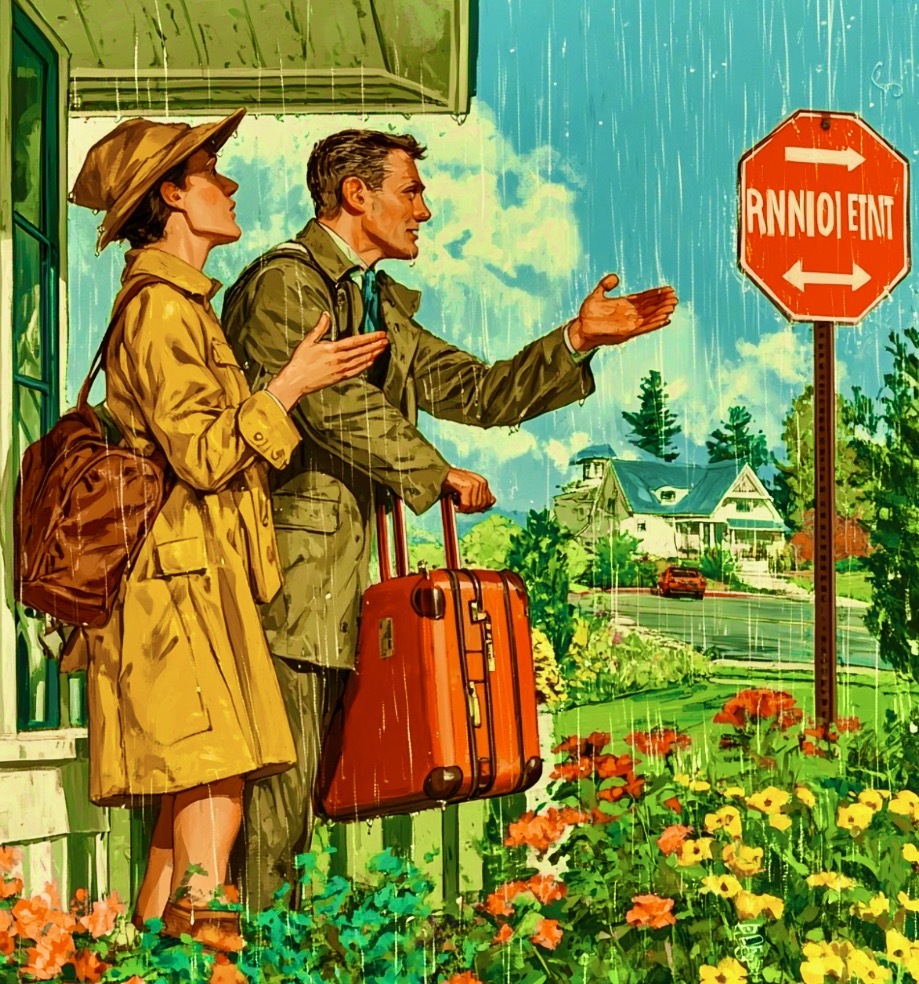 seven majority Muslim countries during TrumpOne—this time aimed at 44 nations in three ‘terrorist’ groupings via intensified visa vetting and blitzy suspensions.
Spring Travel Up In the Air?
So whither 2025 travel prospects and resulting airline revenue? For one thing, pricey majors like Delta and United still foresee year-on-year net increases, particularly should the tariff tantrums subside. UAL is even adding new international (mainly Pacific) routes. However most all majors anticipate schedule and capacity cuts, with tight-fisted management moves such as retiring older airplanes to lower burdensome maintenance costs. Carriers such as Delta and American are withholding their full-year projections pending further review, on a wait-and-see basis—citing potentially further ‘softening’ in all but comparatively higher-end traveler demand.
That means by more price-sensitive travelers like us, whose domestic leisure plans may face inflationary squalls. Among the ‘budget’ airlines, Alaska/Hawaiian Air suspends its yearly review; hedgy Southwest has spoiled its love-fest legacy with new bag fees and reserved seating, SWA’s discordant board downdrafting revenue projections for the year, expressly regarding domestic leisure travel. While Spirit takes flight out of bankruptcy with new CEO Dave Davis, continuing to rebuff rival Frontier Airlines’ merger bid, as it reportedly sheds pilots by the hundreds. Same time, American Airlines partnership bid is eschewed by JetBlue. Otherwise, low-cost carriers will struggle to compete with trolling majors for any declining economy-minded air traffic.
Not to mention Avelo Airlines, which is dropping significant scheduled service in favor of signing on with Homeland Security to fly ICE charter deportation flights, ostensibly to ‘bolster financial stability’.
European carriers are adjusting growth plans as well, focused on maintaining their pricing power—with EU leaders like Ryanair and Wizz initiating annual subscriber services.
Yet most all airlines are up against lagging new aircraft production and delivery, Airbus SE bettering battered Boeing on that score, the US planemaker being further hit by China’s ban on purchasing Boeing planes amid the superpowers’ tariff tit-for-tat—to where Beijing returns to senders (for rerouting) some 50 new 737s+ China had on order. Meanwhile investors like Mass Mutual insurance subsidiary, Barings bet that the aircraft shortage will persist, snapping up aging jetliners for commercial leasing to strapped carriers later in the year, figuring air travel will grow on worldwide.
Flighty Risk Factors.
Reality check: Meantime, we see a spate of scary incidents clouding our sunny, friendly skies—mistakoffs to hapless landings, and everywhere in between. Too often they are linked to another chronic shortage, namely of qualified air traffic controllers in airport towers and command centers.
How else to explain Southwest Air Flight 3278 errantly attempting to take off from an Orlando taxiway March 20 instead of the proper runway? Or another, SWA Flight 2504 having to abort a Chicago Midway Airport landing and ‘go-around’ to avoid colliding with a private jet mistakenly taxiing across the 737’s designated runway?
Such ‘close calls’ involving ATC tower miscommunication with departing/approaching pilots have climbed to upwards of 10 in 2025 in the US alone. Ground/gate incursions have also increased: e.g., taxiing passenger jets clipping wings and tails with opposing planes on crowed tarmacs. Incidentally, what is the rub with touchy regional jets anyway? Particularly the double American Eagles: Flight 4522 nicking Flt. 5490 at Reagan National Airport—one Embraer scraping another.
That is not to overlook recent engine fires breaking out on flights just before takeoff, or shortly after liftoff in the case of SWA Flight 3006, returning to Houston Hobby International airport with a #2 engine fire—134 passengers doing a wing-walk evacuation. And most recently, the slide-chute evac of 300 passengers from Delta Flight 1213 onto an Orlando tarmac, its A330’s right engine having caught fire as the Airbus plane taxied toward takeoff.
Once aloft, red flags range from air turbulence bump and grind or abrupt pitches to cabin leaks and smoke; security diversions to bomb scares/hoaxes, even to unruly cabin aisle takedowns and cockeyed skyjack attempts. Some recent landings have been no happier: Delta/Endeavor Flight 4819’s gear crushing, upside down flame-out of a CRJ900 Bombardier in Toronto; then Delta/E Flight 4814’s steep, CRJ wingtip-runway strike during a hard landing at New York’s La Guardia Airport; add Frontier’s gear breaking landing in San Juan. Moreover, take the current rash of private plane crashes nationwide, or the fatal sightseeing helicopter dive into New York’s Hudson River—resulting in the tour company’s grounding, and a review of Federal Aviation Regulations on general aviation, parts 91 and 135.
Nevertheless, travel-by-air remains statistically safer than either via highways or waterways—according to the numbers, at any rate…
Scrapes to ‘Scapes.
Still, tariffying barriers, economic uncertainty: what to do about it all now? Really, do we pack it in and cower or deftly pack and boogie on? No question here, it’s clearly a know-go. So let’s touch on some budding bases, as we do spring to life…
For sake of argument, even while major airlines bank from building market share to shoring up profitability—chasing ‘premium travelers’ who presumably can handle higher fares—they will inevitably find themselves battling budget carriers to fill their slower-growing economy class sections. Further, majors’ plans to cut ‘unprofitable’ flights (e.g., off-peak) and routes in the quest for higher margins may only open skies for lower-cost ‘spill’ and upstart competitors, likely forcing flash fare wars for potential seats unfilled.
Tariff-for-tat borderline skirmishes affecting travel to/from Canada and Mexico will only heighten domestic US travel, as well as bolstering international journeying with approved real-ID and full visa/passport documentation. Moreover, volatile air fares will open eyes to other modes by land and sea, particularly rail lines—particularly should yo-yoing fuel costs somewhat speed-bump personal vehicular travel coast to coast.
Overall, a comparatively ‘thinning’ travel herd may also serve to lighten onboard dress codes and quell the inflight cabin fever. It may even ease park crowding and reservations pressures, pause some tourism ‘hot spot’ day passes and quotas. This, while Destination Dispersion widens as we prioritize and pursue unique travel experiences for time, energy and resources expended—ever mindful of terrorism and crime worldwide (most recently in Indian Kashmir and Vancouver). Along the way, leveraging any downward price/revenue pressures on lodging, shares, vehicle rentals and third-party booking sites.
Admittedly this survey is only for starters. Here are mere remedial seedlings for a potentially creaky and uncertain season. Now Vamigré is coiled to vouchsafe the bloomin’ whats, whens, and wheres of a verdant Springtime ’25…and how. Indeed, we’re rarin’ to spring vigorously forward—shrewdly escaping, exploring true and through—albeit treading lightly when apropos, not least on the VamoSilver side.
So uncertainties or no, let’s get it on, shall we? With a certain spring in our step…Boinngggg! (MMTC…)
The Duffernial Equation.
(2/28/25+)—As Sarah Palin’s foreign policy expertise amounted to “…I can see Russia from my kitchen window”, the new secretary of transportation’s applicable experience apparently comprises partying in a Winnebago as an MTV reality star.
And thus far, Sean Duffy is still a dedicated party guy, seemingly no less myopic as the one-time VP candidate from Alaska.
Rebukes + Reviews = Regime Battle Ribbons.
The former district attorney-to-US congressman from rural Wisconsin turned Fox News political commentator and lobbyist—also a competitive lumberjack—looks to be a logroller from way back. These days, Duffy has become a loyal POTUS serfer buddy intent on whittling DOT down to a Department of DeTransportation, being more reductive than recreative as he goes.
Shortly after confirmation (77-22 in divided senate), Duffy bussed in as the nation’s 20th secretary of transportation, immediately stripping his desk of all Biden/Buttigieg plans and programs—leaving in limbo recent airline compensation and junk fee mandates, if not Essential Air Service. Meantime, while his choice for acting FAA administrator, agency/TSA veteran Chris Rocheleau, earns plaudits, Duffy’s pending deputy secretary of DOT, Steven Bradbury reportedly brings baggage of Boeing inspection mishandling, as well as contributing links to controversial Project 2025.
Further, having already supported Trump One’s travel bans, Duffy summarily directed DOT to axe corporate average fuel economy standards and EV incentives and charging station support—let alone NHTSA safety measures. Then the newbie transportation secretary got logjammed at a hot box of a news conference in Los Angeles’s Union Station. When he announced a “compliance review” of the $4bn federal funding for California’s High-Speed Rail project, he drew a slew of boos and chants like “Build the rail” and “Don’t delay our trains!” He instead blamed Governor Gavin Newsom for HSR waste, delays and setbacks, who soon countered that the state’s Rail Authority provided $10.5bn of the $13bn funding, all fully accounted for, at that.
This, after the Duffer, father of nine, decreed that his department would stress and prioritize family-friendly policies/programs “…giving preference to communities with marriage and birthrates/young children higher than the national averages.” Meaning everybody, everyplace else is aged out of his transportation world?
“Gimme a Break…”
So complained Secretary Duffy (just caricatures↓) when attempting to dismiss concerns over the TrumpTwo administration’s ‘big dumps’. That is, massive federal staff reductions and spending freezes government-wide—not least from the Federal Aviation Administration. Fewer than 400  positions (352), only probationary workers less than one year in, no air traffic controllers nor mission critical staffers, Duffy insisted (oh, really?), citing greater efficiency, and deficit driven budget cuts. He followed up with a broader five-points ‘report card’ admonition that if FAA personnel can’t justify their employment, “…maybe (they) shouldn’t be working here.”
Accordingly, contrails of Reagan’s Revenge were taking flight. For in 1981, newly minted President Ronald Reagan confronted a rock-ribbed strike by the country’s air traffic controllers, informing their labor union, PATCO, that he was firing the lot of them, filling control centers with rookies and scabby standbys. The towering massacre was a staffing hit from which the FAA has never actually recovered, worker shortages clouding the aviation agency to this day—stretching, stressing out 14k ATC positions nationwide—in airport towers and radar rooms.
The COVID pandemic later prompted a flurry of resignations and retirements—controllers facing live-traffic deactivation at age 56 (w/o waivers). Consequently short-handed, ATCs often face mandatory overtime with unsparing 10-hour shifts, 6-day weeks as air traffic ever increases over/at airports large and small. Thus bipartisan pressure has been building in Congress to factor a “Safe Landings Act” into the FAA’s next reauthorization for better, safer ATC working conditions and job protection (whistleblowers included).
Duffy countered that DOT reductions pose no risk to air safety. But agency employees maintain that such administration safety and technical support workers are essential to ATC tracking and navigating aircraft across teeming runways and skies, particularly as ‘close calls’ abound: from Delta’s smoke-filled cabin to Chicago/Midway Airport’s near SWA-business jet runway crash, and approaching DCA planes receiving false midair collision alerts.
Critics further note Department of Government Efficiency (DOGEy)’s impact on the FAA’s inspection responsibilities—compromising oversight of aircraft production (as in Boeing’s in-house ‘designees’) and outsourced maintenance to Brazil, el Salvador or Singapore. Duffy reiterates it’s fewer than 400 workers (to date), pleading “…give me a break.”
Muskovites’ Wily Card.
So be it, since the Duffer was only rogering the ‘diktats’ of DOGE Tzar, Elon Musk, autonomous sole minister of the government-wide cut-and-gut regime. He of the PayPal Mafia, Tesla and SpaceX fame and fortune, who has Neuralinked himself into POTUS and White House itself, Darth lording over cabinet members like Duffy, who are dutifully bending and bowing his way.
Indeed, Musk’s SpaceX engineers have already insinuated themselves into FAA facilities, assessing, suggesting upgrades to the agency’s ‘archaic analog, copper-wire’ technologies—Duffy tagging along. Next step, SpaceX’s takeover of FAA communications to air traffic control (Enterprise Network Services/FENS), clipping Verizon’s multi-year, $2.4bn contractual wings to revamp a legacy system rapidly failing and breaking down. Thus Musk’s Starlink is poised to muscle in, the FAA looks into canceling the Verizon deal, legal static come what may.
Who’s to stop them, given the federal government’s existing contracts with and dependence on SpaceX’s Starlink satellite network for communications and national security connectivity. Not to mention how Musk’s past beefs with the FAA over his rocketry, with NHTSA over Tesla safety issues, could color DOT oversight—while he cashes in on his mind-gaming TrumpTwo windfall, conflicts of interest or no.
Thus in fairness, Duffy’s DOT looks to be no joy ride—no graceful aging here—his training wheels having been all but chainsawed away. Still, legalities and appellate litigation aside, the transportation secretary rolls out POTUS’s fiat to: “…Prioritize Excellence, Competence, (utmost) Competitiveness and Beauty when rebuilding America’s highways, tunnels, bridges and airports. He will ensure our ports and dams serve our Economy without compromising our National Security, and he will make our skies safe again by eliminating DEI for pilots and air traffic controllers.”
by, among other things: Duffy sees SpaceX advising the FAA on how to deliver “a new, world-class air traffic control system that will be the envy of the world.”
Sweeping vision or stultifying myopia; level headed or in over: time will tell. Then again, Duffy the ‘Lumberjack’ has since announced that the federal government/DOT is moving to bolster the air traffic controller corps (currently 3,800 chairs shy) by ‘supercharging’ training at the FAA Academy in Oklahoma City, and increasing trainee pay to decelerate class churn. Nevertheless, ATC training lead time can be long and grueling. Yet rushing newbies along to meet arbitrary, if not reckless DOGEy data dumps and demands is hardly the best route to safer air travel and restoring public trust.
So Vamigré will see if the Dufferential Equation adds up, evens out…or reverts to the mean. That is, whether the Lumberjack’s logrolling reality show wins him a medal for MAGA Transportation Valor, or gets him DOGEd back under the bus. (MTC…)
Harm for the Holidays.
(1/3/25)—Sadly, amid all the holiday joy and good cheer came this slayload of headline-grabbing coal. What to make of the mishappy holidays just past: crowd scenes begat crowd screams, inflight safety is no longer so air tight? Let’s roll out tales of the yellow warning tape…
Begin with a pre-Christmas salvo of mysterious drones and laser beams bestrewing skies and alarming travelers/fliers along the US Eastern Seaboard. Magdeburg, Germany’s cherished Christmas Market was soon attacked for a second straight year, an activist former Saudi psychiatrist high-speed plowing through the festive booths and stalls in his SEL before being ‘neutralized’. By Christmas night, a family gathering turned downright Yule ugly as three members were shot and killed on a Phoenix Sky Harbor Airport concourse.
Shortly thereafter, an Azerbaijan Airlines Embraer 190 Flight J2-8243, en route from Baku to Grozny, was erringly shot down over Kazakhstan December 25, killing 38 passengers—reportedly by Russian antiaircraft weaponry. Then a South Korean Jeju Airlines Flight 7C 2216, a 737-800 from Bangkok crash landed at Muan International Airport, possibly victim of bird-struck engine failure, belly sliding in with malfunctioning flaps and landing gear, exploding as it hit a retaining berm at runway’s end, killing 179 of 181 aboard.
Moreover, a Japan Airlines jetliner collided with a Japanese Coast Guard plane which was mistakenly taxiing onto a Tokyo airport runway January 2, five CG crew members perishing; the nation’s Transport Safety Board points to air traffic controller error.
This, while hellacious winter and tropical weather conditions caused delayed and diverted flights the world over, if not cascading cancellations, as record numbers of travelers surged to take leave. Let alone how climate change extremes were punishing drivers hitting the snowy, icy roadways.
Tourism, Meet Terrorism.
Topping (or bottoming) it all was New Year’s Eve, when an ‘ISIS inspired’ Texan terrorist barreled a rented truck along New Orleans’ Bourbon Street—still thronged by revelers at about 3 a.m., mowing down scores, taking at least 14 lives. The focus turned swiftly to missing  traffic bollards, scheduled to be repaired, replaced on Bourbon Street—just not soon enough. For Super Bowl and Mardi Gras crowds also loom, while NOLA locals are uneasy about the fabled street’s situation as it is.
Meantime a much-decorated Army Green Beret soldier on leave from Germany rented a Cybertruck in Colorado and loaded it with explosives/fireworks, driving to Las Vegas, setting it and himself ablaze on the portico of a Trump Hotel—suicide mission accomplished, no other victims or injuries reported.
All told, there were holidaze woes galore. But whoa: Think of all the places where the holidays off went so beautifully (re: Destination Dispersion, anyone?). Still, how does this mortal mayhem affect or deflect a traveler’s course, particularly as tourist traps become more like tourist targets?
Point being, do we cower, cave and kaputulate to the turmoil and terror? Or do we have no truck with the travel uncertainties of today’s troubled world, instead doing what ‘Nawlins celebrants did New Year’s day: Got right back out there, besting the whole crowded holiday scenario, and otherwise doing no harm. Just not necessarily until 3 a.m.—with all due respect to Gary U.S. Bonds. Bonne Année! (MTC…)
Après Turkey-Day Grilling.
(12/5/24)—Pass the tryptophan and Dramamine: After another Thanksgiving holiday travel record, the U.S. Senate Permanent Subcommittee on Investigations made a big to-do on December 3 about soaring airline fares and fees. This after more than 80m traveled over the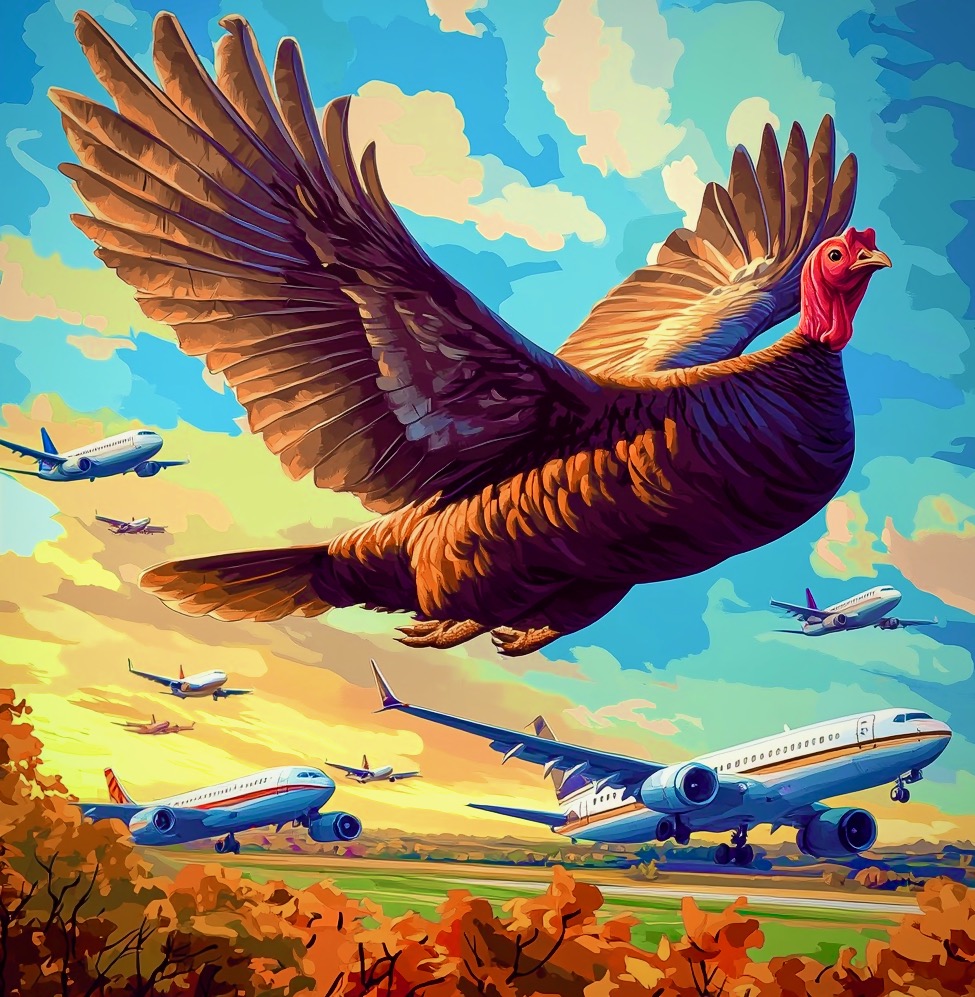 week, upwards of 5.84m flying—with international flights surging by 23%—TSA checkpoint numbers sky high. Some 72m traveled by auto, nearly 2.3m by other means—without major glitches unrelated to weather.
Summoning the leaders of biggies American, United, and Delta, the bipartisan panel also grilled counterparts from low-cost Spirit and Frontier over the multibillions of dollars they have gained from their customers between 2018 and 2023 onward. Turns out the five carriers have collected some $12.4 bn from seat fees alone, according to the committee. Thus fee’d up was the tone of the two-hour hearing, chaired by Senator Richard Blumenthal (D-Connecticut).
Fears For Tiers?
Beyond flight/scheduling squeezes and resulting fareflation, the committee zeroed in on this rampant feeflation—namely the unfair and arbitrary application thereof. Senators noted flight/seat change, baggage, carry-on and various cabin comfort/amenity surcharges—accusing the airlines of using captive airline customers as ‘walking piggybanks’, leveling bounties and shakedowns, gouging for every possible dime—to the tune of $1bn in change/cancellation and $7bn in checked-bag fees over 2023.
Make that unleveling fees on a customer-specific basis, unbundling via stealthy algorithms, tierfully discriminating as to profiled ability and willingness to pay more: increasingly resulting in differing baggage fees for the same flight.
Beyond rebuking the major carriers, panel members cited how low-cost Frontier Airlines and beleaguered Spirit painstakingly collected such fees between 2022-23, actually paying their gate  agents and other employees to catch ‘shoplifting’ passengers who had not paid required baggage check and oversized item fees.
This ‘Gate Gate’ apparently continues, Denver-based Frontier paying its personnel a $10 per ‘scofflaw bag’ bonus (totaling $26m and counting) to catch items that won’t fit trimly beneath one’s seat. Meanwhile Frontier charges up to $99 for overhead bin space, Spirit between $15 and $77 per bin.
Bounty Hunting vs. Shoplifting?
The assembled air carrier CEOs countered that so-called ‘junk’ fees and dynamic seat assignment models are a key part of their revenue picture amid ever rising operating costs. They claimed air travel has never been so affordable, and customers are flying more than ever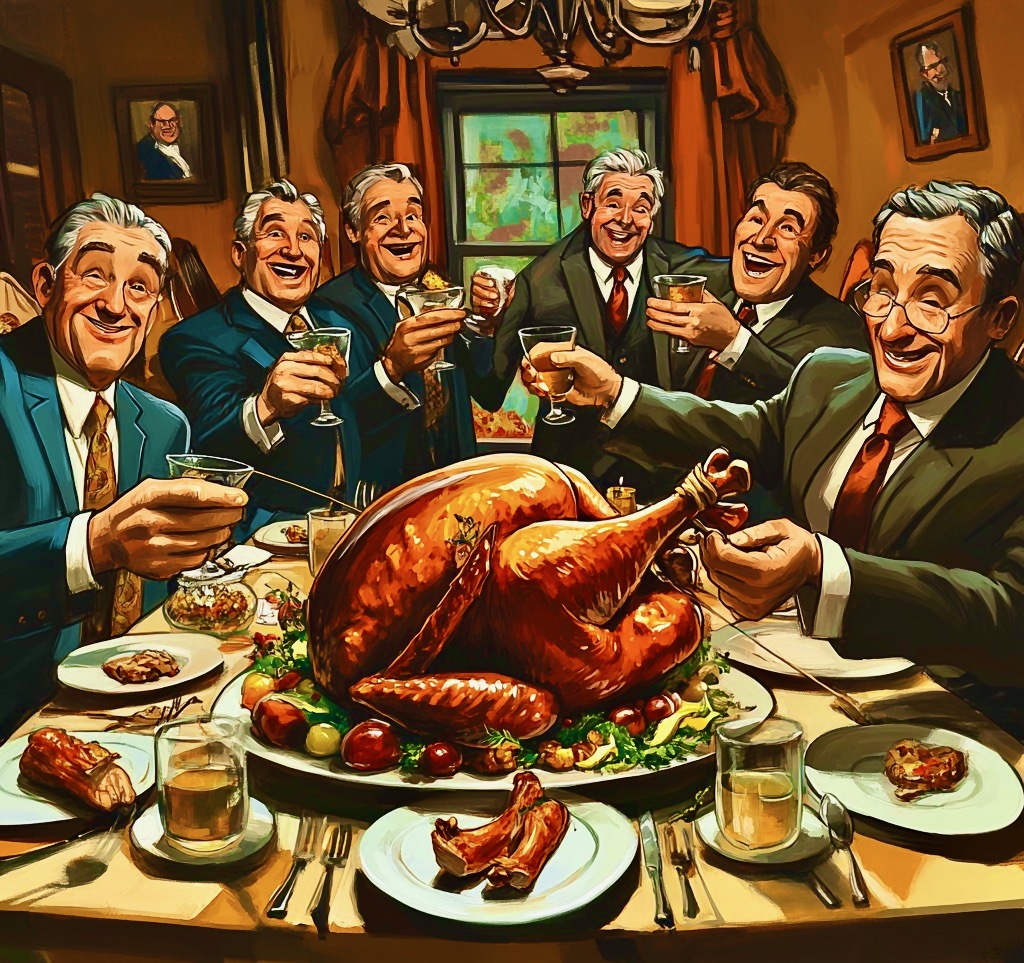 these days; that its passengers are paying fees (e.g., for premium seating, location to legroom) by choice. They also acknowledged the need to attract budget travelers, accordingly providing fare/fee options for every customer.
Same time, the airline industry has sued to block a Transportation Department ruling on upfront fee disclosure, lobbying against bipartisan legislation to mandate “reasonable and proportional” change and and bag fees. Carriers steadfastly maintain that their responsibility is to generate the most revenue they can to remain profitably and safely aloft over the long haul.
Nevertheless Senate lawmakers want the D.O.T. to investigate these airline practices and finalize rules on fee disclosure (esp. for family seating )—more transparency being necessary so air travelers can better plan and budget for trips. Blumenthal did laud an October Transportation Department ruling on automatic cash fare/fee refunds for flight cancellations, and foresaw two additional aviation reports by year’s end.
Given everything, these are issues Vamigré has canvassed/covered all along. Be that as it may, this hearing was much to-do about nothing but grievances. So will the airlines significantly change course in terms of fare/fee revenue—particularly with a new crew soon taking Washington D.C.’s helms? When turkeys fly…likely when fat turkeys fly…
Still, gobble forth we will. Our eyes clearly on the kiosks, gates and skies, blindly winging it no longer…rather flying triptofan ravenous and Dramamine free. (MMTC…)
Vamostray = Splittin’ to the Différence.
(10/22/24)—Hit it where they ain’t. Vamigré has long called it (and for) Destination Dispersion—going for the elsewhere, the other ways, the anyhows and wherefores when we travel.
Because there has been more than enough holiday herding and crowd strife of late—to where the excesses of over-tourism are finally coming home to ruination as we fall into a brilliant autumn.
Tourism Turned Tourrorism?
Firstly, let us recount the misplays and dismay as US Labor Day and worldwide celebrations were on approach: Witness teeming terminals, jam-packed flights, gridlocked roadways, overheated hotspots, social-media selfie swarms, grotesque site stomping and cruise swamping. Hallowed landmarks and monuments were being defiled and graffiti tagged, cherished parks trampled underfoot, Greek islands being overrun and setting fees (esp. ship docking). Add shinning up the Eiffel Tower, crime tourism on the rise—all told, our entire planet is largely being hugged or mugged to death. While the tourism industry blames low-cost airlines, short-term rentals, local infrastructure failings and more tourists than ever. Trust and goodwill falling on either side.
In response, Venice, Italy increases its day-visitation fees, doubling down on restriction times; besieged parklands large and small tighten reservations and quotas, Oahu, Hawai’i shuts its historic stairs, Bali posts a tourist entry tax, locals by the thousands protest tourism run amok in historic UK villages (e.g., Cotswolds) or Mallorca—others taxing, even douse tourist crowds with water guns in Barcelona. Stir in Amsterdam red-lighting; view-blocking barriers at Mount Fuji, hassling hoards on the Isle of Capri. Talk about falling off the high-season welcome wagon…
Difference Re-Maker.
So what’s the cure for such summertime blues? Falling into a healthy, reviving dose of TDD, or Travel Destination Dispersion—namely a re-set, redirection that Vamigré has long championed. To refresh: it means deTouring from tourrorism excesses and ugly behavior. Detaching from over-trod tour groupthink—the whole tourism marketing industry site search/saturate/destroy syndrome; decelerating from chronic, ever lengthening highway bottlenecks. Departing from same-old places and scenarios, splittin’ to somewhere different, parts unknown—letting spontaneity ring true. It’s not about getting over all tourism, just getting over over-tourism.
TDD builds upon a foundation of foresight, flexibility and fortitude, veering toward more  shrewdly fare-minded booking, traveling off season/hours, demanding truth in scheduling by more reliable carriers; utilizing alternate, less clogged airports/terminals—better, more economical service and recharging stations. Thus furthering more uniquely enjoyable, enriching destinations/experiences—while dodging cyber and labor strikes. En total, deploying a fuller range of travel sources, supplier and vendors best aligned with Vamigré standards—not depending on any further governmental/regulatory remedy.
So why not re-steer the course, drop the bucket lists and f—k-it trips? Lay fewer TIRDs (reasons for tourism industry’s rising dissension). Freely choose to value experiences over extravagance and exploitation; embrace selective serendipity, support locally over just package deals, refocus on elsies rather than only selfies by turning smartphone/camera lenses back around. Not least, show some respect out there—and that’s only for starters…
In a word, we say let’s VamoStray! Beginning with yet another record-setting three-day+ Labor Day weekend, 17m TSA scans were expected, with 85-90% of holiday travel to be by car/SUV, gas prices marginally down, airfares nominally lower as well, smartly capping another surging summer season, readying for what fall’s into place from here.
Meantime, what VamoStraying means more specifically is well on the way, wherein Vamigré will surely be showing and sharing the way, foilage to sun breaks, all autumn long. (MTC…)
Fallout Amid the Frolics.
(10/20/24)—Alas, to begin wiht, where would we be without a frightful October surprise, particularly during an election year? This one comes in the form of a US State Department ‘Worldwide Caution’ travel alert, owing to unrest and worse amid the current Israel-Hamas-Hezbollah War. The warning cites potential for violent demonstrations and terrorist attacks anywhere, anytime in the contentious days ahead. For more detailed information on the advisory, particularly regarding Israel, Gaza, the West Bank and broader Middle East, visit TripWire and travel.state.gov…
Falling For Fests and Foilage.
Otherwise scare tactics and fallacious thinking abounds: as in, (to paraphrase Senator Arthur Vandenberg/1947) travel stops at the summer’s edge. Yet high-season foibles, failures and frustrations have now significantly fallen by the wayside, while autumn travel looks to be a comparatively fresh and welcome breeze in the wake of copious traveler outlays and soaring airline/industry profiteering.
What’s fading in the rearview mirror? Hopefully changing climate weather extremes—the searing global heat domes and flooding rain storms, a Morocco earthquake, Maui firestorms and choking smoke from mega-burning forestry. Add in TSA  checkpoint snarls and FAA air traffic controller staffing shortages, heightened by the long looming threat of a US government shutdown. But on a wing and prayer, we turn the corner and seasonal page.
Autumn In The Air.
Now with the ‘revenge travel’ surge easing, airline service/performance should improve over a summer of overheated flight delays and cancellations (CanDels), capped by American Airline’s record federal fine for flight delays.
Still, carriers will continue slashing capacity, shifting schedules, dropping routes with little or no notice. Inflight turbulence, engine failures and birdstrikes will plague air travel no end, as will white-knuckle takeoffs and hard landings and the troubling increase in taxi/runway incursions.
Throw in over-taxed pilots (despite hefty pay raises) and crew/stew labor strife (e.g., raising the mandatory pilot retirement age from 65 to 67); airlines coping with emissions pressures and tardy cleaner jet deliveries), plus scouring for bad or fake aircraft replacement parts: Hopefully the summer traffic jam’s demise will serve to clear those cloudy skies.
FallOut: So fallback strategies are in order, including scouting out cheaper airfares in the months ahead (however whack-a-mole fleeting), even booking early for as far out as summer, 2024, while exploiting the postpandemic economic pressures on high and/or low fare carriers. Being mindful of dodgy ‘all-you-can-fly deals, mileage reward roulette, sticky hotel/lodging rates and such, not to mention airlines’ penchant for quick flight departure changes, or jettisoning flights and routes altogether with little or no notice. Nor will we wait idly by for Congress to act on predatory airfare spikes and crackdown on insidious junk fees.
Nevertheless, this bracing fall season should help cool that summertime fever in the skies, particularly soaring blow-ups in overstuffed airline cabins—the overhead bin battles and territorial seat/tray skirmishes, much less the onboard food fights, stabbings, aisle scrums and pepper spray. Little wonder the  FAA seeks more fines (up to $37k per incident/case) and criminal prosecution of passenger misbehavior (over 270 cases filed since late 2021)—on everything from lav smoking to physical/sexual assaults. Ahh, vamateur hour, au revoir…
Fall Out: But pre-flight, we’re gonna be working through, walking around stuffy, crowded airports, wary of creeping fees and the gouging gamut of retail/concession prices along interminable concourses. Moreover skirting the mayhem—departure gates to baggage claim—while wheedling into luxury airline lounges, much like chaffering into luxe hotels when opportune. By the same token, tactics such as bag-fee angler vests and skiplagging warrant all due consideration.
On the technology front, computer snafus will still spark FAA tower/tarmac delays and aircraft ground stoppages, be it over software glitches or hardware malfunction, the EU and UK no less vulnerable to systemwide data/information breaches and crashes. New TSA scanners, lauded as more electronics and liquidity friendly, are still no match for crawling peak-period security lines, PreCheck, Clear of marginal help. Updated data processing and procedures have not yet pared visa and passport application/issuance backlogs—Global Entry expedient efforts notwithstanding—while feds are accused of trolling subjects’ social media activity in US visa cases. Yet as techies say, almighty AI alchemy/salvation is well on the way.
FallOut: So we’ll be ever combing, comparing and contrasting airline, lodging and third-party ticket/reservation websites/mobile apps for deals and steals, for advantages and abuses—targeted to specific trips and itineraries—right down to paperless reservation/ticketing and baggage mishandling (Air Tags anyone?). Also focusing on high-tech snafus and hacks, as well as transcending the toxins and pitfalls of T/T social media. Tracked as well will be the corporate consolidation of flight/fare giants like Expedia and Orbitz, as well as ancillary fee ‘unbundling’ and pay-per-reviews on too many carrier proprietary and third-party booking sites alike.
Tooling, Railing and Sailing.
Same time, different station: summer ’23/24 train travel set new US passenger records, as Eurail ridership gained steady, heady steam across a sweltering continent. Moreover, AMTRAK is undergoing a systemwide  makeover, gaining from a $1.4bn Congressional outlay for rail upgrades and repairs. Sleeker railcars, better wifi: and that comes as higher speed rail advances, from Florida’s privatized BrightLine service to accelerated construction of a Las Vegas-to-Los Angeles leg, rail bed to station upgrades—eventually linking with California’s Central Valley HSR network.
Cruise lines enjoyed packed post-pandemic ships the world over, with bookings strong into the Fall. This despite a destination  backlash against bloated, floating city behemoths (e.g., limiting daily docking), reports of deck chair squatting, food/balcony straits, soused mateys overboarding guardrails into the deep, and coronavirus outbreaks revisited, not to mention a luxury MV Ocean Explorer ship stuck in Greenland mud. Nevertheless, some cruise industry heavyweights are actually sailing toward private resort islands of their own.
Despite soaring gas ppgs, roadways were clogged all summer long—cars, wagons, SUVs, camper vans and motorcoaches taking to the highways in pre-pandemic numbers. Too often, too many drivers to too few popular places: Traffic jams ruled the roads, no matter the inflated cost of buying and operating today’s techno-fiddly motor vehicles, no to mention motorcycles. For there are just too many clearer, more colorful fall joyrides to be so detoured or denied.
Which in turn raises the matter of fossil fuel versus hybrid and electric power (with hydrogen fuel on the horizon). EV sales have increased dramatically, regardless of per-vehicle price tags, iffy driving range  estimates, tech/software glitches, heavy battery fires—but mainly the equipment/deployment shortages of charging networks. Then come the issues of weighty vehicle traffic safety, let alone the prospect of more and more driverless vehicles—cabs, UberLyft, Amazon—on city streets, highways and byways. These concerns will soon be compounded with the takeoff of flying taxis (namely eVTOLs like Wisk Aero and Joby Aviation), WIG electric seagliders, shuttles and various individual cars.
FallOut: So all modes and models will be boarded, floated and/or taken for a spin with regard to comparative efficacy, service and safety…seeing to it we’re not derailed, waterlogged, backfiring or otherwise just plugging along on our scenic autumn drives.
Destination Desperation.
To be sure, the summer’s post-pandemic ‘revenge’ tourism has surely taken its toll on destinations and the environment worldwide, overwhelming ‘hot spots’, domestic and international. Venice (struggling to fend off a total tourist takeover), red-light Amsterdam and other popular destinations establish visitation quotas, mount restriction bollards and selfie shields, but still tourists still come and congest customary  hubs the world over—with crime, hazards and worse awaiting them, or not far behind. Yet other, less traveled places and possibilities still struggle to regain their pre-COVID footing.
Hotel chains and other lodging logged record bookings in kind, with attendant rate raises, tightened cancellation policies, invasive ‘smart’ room surveillance, increased service abuses and guest complaints. While online share services like Verbo and HomeAway can be a consumer crapshoot, AirBnB posting the lion’s share of horror stories—stark, raving orgies to peeping toms—even triggering a New York City clampdown.
Parklands, preserves and heritage sites were overrun as well, despite megafire/smoke and flood threats—litter, vandalism, trespassing and landmark/monument desecration following in too many cases. Stricter reservation/allocation measures result in US national parks, from the Adirondacks and Everglades to Yellowstone and Yosemite. The summer’s crowd muddle was perhaps best illustrated in Burning Man’s flash-flooded muck and mire across Nevada’s Black Rock Desert—a sea of Burners getting swamped and stalled in place for days. This, as Disney Corp. doubles down on pricing and expanding its plastic fantasyland in Orlando.
FallOut: So we’ll be exploring and fully experiencing autumnal trips, routes, settings, events and circumstances—little known local treasures to farther flung adventures; lesser travelled roads and beaten paths: insider secrets to whole other sides. Being mindful of potential crime and dangers therein. Shrewdly paring prices and skirting proscriptions when and where we may. Holding that Destination Dispersion, not hot-spot clotting is the better revenge, we will soon be toasting and sharing Vamigré values and adventures via Club Vamaway…
Scrutiny On the Bounty.
Beyond that, topics of more personal nature are surely on the tray table. Falling into view are matters of traveler health and fitness, of reconciling work and travel, esp. remotely—as in carry-on bags versus checked luggage, what with the advent of more spacious Airspace L overhead bins. Or given everything, travel insurance: yea or nay? Add in affairs of spirituality and romance on the go—not to mention the  spirits and substances that can help pave the way, as other issues fall in line.
Now be VamoSure to keep eyes peeled for wat’s to come—beyond the splendiferous festivals and foilage—seasoning to make for more venturesome, comfy and colorful roving this whole Fall through. For who says that travel stops at summer’s edge? Indeed, fallacy is as vamateur tourist does… and if the ‘revenge’ crowds are not up to speed on autumn travel, we’ll be glad to take the Fall ourselves. (MMTC…)
Summertime: Sun & Safety, Meet Scares, Scarcity.
(7/23/24)—The heat is on, torrents are as well. The more seasons change, the more change comes to the seasons—and not necessarily for the better. As in hotter, hotter; drier, drier; wetter, wetter; muggier, muggier, stormier, stormier and wilder, wilder the world over.
Not that climate change stops us in our tracks and treks, for more than 70m US travelers took off by air or roadway over the July 4th holiday week alone, setting TSA screening records—coming and going—in all, 7% above rip-roaring, roving 2023. This mass movement comes amid ever higher air fares and nominally dropping gas prices, in the face of too-hot domes, flash flooding (particularly along the East Coast, with crippling airline groundstops and bottlenecks), plus fire/smoke dangers and early tropical depressions.
Then came a faulty CrowdStrike Windows OS software update, perhaps the largest IT outage in history, which instantly crippled some 8.5m Microsoft devices last Friday morning, acutely affecting airline operations worldwide. Termed a security update glitch not a cyberatt yet it caused likely worse air travel chaos and groundings—nearly 10% of all domestic US cancelled by mid afternoon—stranded, bewildered travelers confronting communications breakdowns and schedule boards frozen in Windows’ dreaded Blue Screens of Death.
Though the Texas-based cybersecurity company released a software fix by day’s end, the damage had been done, requiring every Microsoft-configured server and device to be booted and rebooted time and again throughout the weekend. Meanwhile travelers frantically attempted to access scarce carrier information on cascading flight cancellations and delays (CanDels) by the thousands—what with aircraft and crews scattered throughout stalled, misrouted systems. The upheaval has dragged on into early week, with scant assurance that such sudden service disruptions, à la SWA’s holiday meltdown in December 2022, couldn’t become yet another new reality of techonnected air travel today. (VamoTech & Technicalities for details…)
Still, our feet are clearly willing, even though the fleets are weak; that is, plenty of journeys planned but too few airliners to fill. So the squeeze is on, as well. According to most aviation authorities, flying is statistically safer than ever—yet that doesn’t mean it hasn’t gotten scarier up there.
New aircraft deliveries by Airbus and troubled Boeing have lagged, leaving airlines short on capacity. In turn, major carriers have dropped routes and trimmed flights/scheduling—leveraging a demand/supply imbalance to inflate fares and excuse away flight delays and cancellations. They escalate upselling and overselling with impunity, while bemoaning (overworked) flight and cabin crew labor pains. Conversely, existential fiscal problems plague sorely needed lower-fare carriers, even Southwest Air.
Same time, the US D.O.T. and FAA struggle to keep up with staff vacancies, from TSA checkpoints to air traffic control towers, and the alarming increase in near misses, close calls, mechanical failures, much less airplanes getting turbulently tossed around, up and down mid-flight.
Nevertheless off we go—fearless, tearless—beating the heat, leaving the swarms and throngs behind. We’re overcoming packed flights, clogged highways, steamy weather extremes, short-sheeted lodging, vehicle rental gouging, visitor fees, reservation caps, train derailments, shipboard outbreaks, on/offline tourist traps and scams; food fits, selfie scrums, beach algae, shark attacks, bad actors and scenic crime. Bring it all on, for there’s no stooping, or stopping us now.
This of course is just scratching the summertime surface, seas and skies. Reason enough why Vamigré will be all over all of it, all season long. (Much to come…)
Springboard with Savvier Fare.
(3/21/24)—Adieu to the winter that was, and wasn’t—the deep freezes and off-season heat waves, the white-outs and atmospheric rivers. It’s finally springtime to bust out, to chuck and chill, to refill and fulfill: 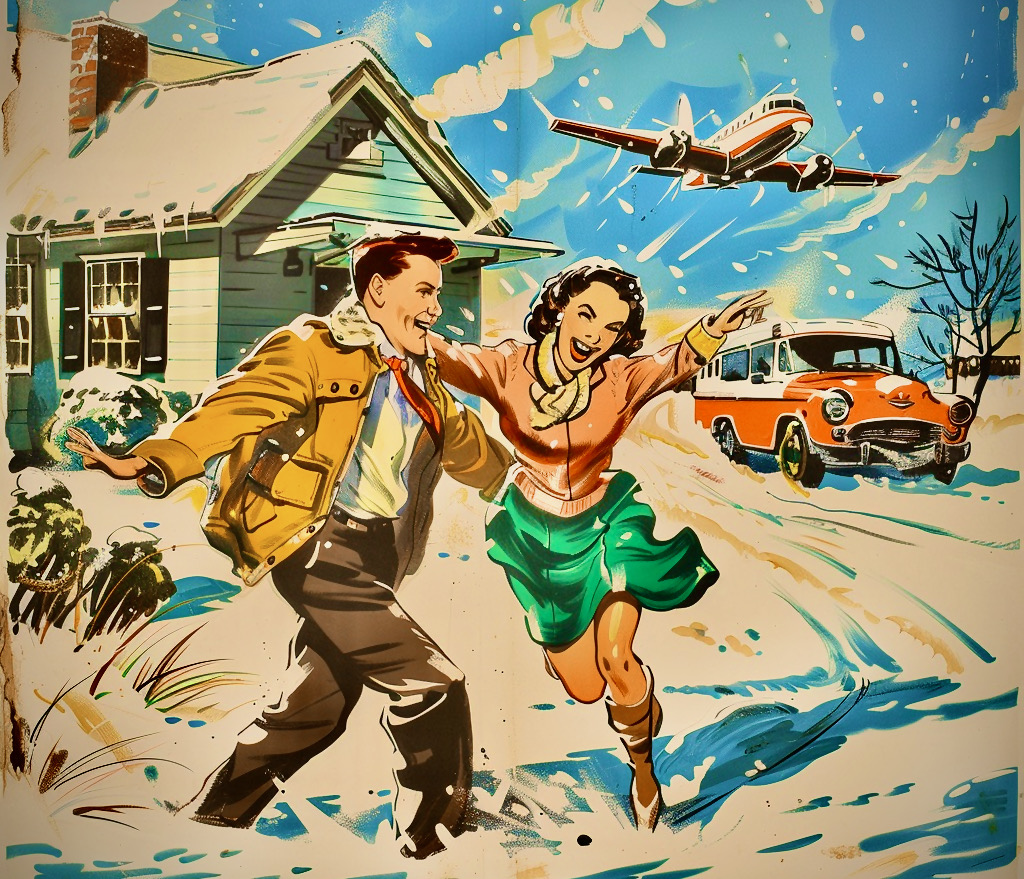 lose the hibernation and cybernation, go for some footloose flybernation and bye-byebernation…
Time to break away from winter’s avalanches, torrents and tornados, from munching potato comforts on the cozy fireside couch. For we are springing into a bright new season, fresh spaces and pace, wide open to wonders around the corner and the world at large—surpassing some hurdles and speed bumps along the way. So high time to spring for a flyer to parts and ports known and unknown, unique destinations and experiences near and far—eager to preview and review…
Scares and Scarcity, Still.
Recent United Airlines and Boeing MAX horror stories notwithstanding, commercial flying is said to be ‘statistically safer’ than ever before.. Moreover, most all airlines appear to be going the budget route, at least for the moment, and whack-a-mole lures abound. Call them early bird fares, but the Big Four carriers are doing bargain battle with smaller low-cost and ultra low-cost lines like Alaska, Allegiant, Frontier, Spirit, even jilted JetBlue. And we travelers can split the differences, reap the spoils.
Thus best to book ’em while they last, because today’s fares are itching to inch upward, and fees (change to bag) are already piling on; just as airlines trim their routes, increased ‘CanDels’ and bumping surely to  follow. It may also be prudent to keep the true LC and ULC carriers in mind and booking mix, lest they be ground into the ground by predatory majors. Which would leave American, Delta, United, if not Southwest Air free to fare and fee us travelers to the heavens—not to mention weighing passengers for add-on charges.
Otherwise, despite ever slow delivery of new Boeing and Airbus aircraft, planes are getting cleaner and greener by the day. For their part, FAA and NTSB regulators are becoming more attentive to aircraft manufacturing/production quality and safety issues and/or incidents. Yet beyond that, the FAA needs to better, fully staff besieged air traffic control towers— if we travelers are to continue confidently springboarding our street cars named desire.
Meanwhile, TSA security stations are attempting to move more smoothly these days, incorporating self-service Innovation Checkpoints, CAT (credential authenticity) technology, CT (and gradually touch-free, full-body) scanning into it pre-flight security measures. Airports themselves are increasingly models of comfort and high-tech convenience (e.g., automated/digital processing)—currently better equipped to accommodate passenger traffic before the inevitable terminal surges and gate storms further down the travel calendar.
Modus Alternatus.
Springing for other modes: Regardless of the motorcoach indignity of Greyhound selling off its storied bus terminals—forcing passengers to wait curbside in too many dicey locations—other modes appear to be advancing. AMTRAK continues to bolster its national network and improve services/rolling stock via increased increased federal support, with high-speed rail accelerating coast to coast. Offshore, cruise lines are packed to the gills and trolling for more.
 Now if we’re springing for road trips, motor vehicles are largely safer, speedier and better connected than ever: sportsters to SUVs to tricked-out vans and Winnies. Power wise, gassers, hybrids and EVs are fighting across lanes for highway dominance, what with charging stations building out nation- and worldwide. Vamigré will be driven to cover/compare them all.
Springing For Good.
That’s not to say we won’t be looking to spring from the inevitable tourist crush in places too hot to further clot, already sparking visitor entry fees, and how Destination Dispersion can help relieve that maddening  congestion.
Also under the Vamoscope will be creeping air fares and crimping service. Third-party bookers vs. airlines’ proprietary reservations/ticket websites; much less ticket/pass swiping gate crashers. Add in gimlet eyeing bad onboard behavior, selfie excesses and alarming act-outs—from defacing monuments and the Mona Lisa to bodily violence including traveler robbery, rape and murder. In other words, the going gamut of cautionary tales, and ever onward…
So many scenarios, so many strategies, with details on the way—all in the service of hitting the bricks with fresh licks and slicker tricks, putting savvier Vamosteps in our spring, whatever our age and stage. (MMTC…)
Warming to a Winter Wanderland.
(1/10/24)—Fast forward: Skating into the winter months. Autumn falling to the road side, we embark upon our winter of disconfinement—breaking free, breaking glad, warming to the idea of getting out there, be it to sleighs or rays, slopes or swells—running hot or cold…or a little of both. 
Are we departing like it’s 2022? Not hardly, as flights are running somewhat more closely to schedule of late (weather permitting). TSA checkpoint stations are operating more smoothly. Surface transportation is better geared toward coping with diversions and disruptions on/over the road. At least when compared (by most mobility measures) to last year’s holiday season meltdown.
So zip up, strip down: layer on the Gor-Tex and polar wear, or  shed the garb altogether, skate across the ice and snow or chill along the shore. Only we best not turn a cold shoulder to the pratfalls and haphazards that continue to prevail worldwide once we do…
Freeze Frame, Breeze Frame.
Crete to Cabo, Crans-Montana to Crested Butte—c(gl)amping in Tongass or Denali; vamping in Budapest or ‘Nawlins, tramping through the tropics as the summery Southern Hemisphere abounds. Winter is briskly upon us, however we frame it—whether we seek to warm our cockles or frost our very bones.
Brrrr, either way, the ice jams cometh. For even with the change of seasons, some things don’t seem to change, if they’re not frozen in place. Granted, coming out of a stormy holiday week, it surely does appear domestic air travel has improved significantly over 2022, despite a record number of passengers and severely inclement weather conditions coast to coast. Even with Spirit Airlines’ misrouting a lone six-year-old Philadelphia boy—bound for Fort Myers, Florida—to Orlando instead.
Nevertheless an Airlines For America trade group pushes the US Department of Transportation to act upon the ‘precarious’ air traffic controller shortage (currently some 3k ATCs below target levels), and address/rebalance commercial vs. private aviation traffic, specifically as overcrowded skies 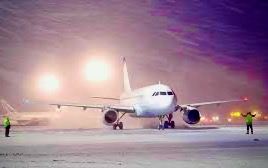 trigger further carrier flight delays and cancelations.* This, from an airline industry that continues to slash capacity, shift schedules, and drop routes altogether with little or no notice amid soaring profiteering—big-five carriers faring better than lower cost/budget rivals overall.
* Case in point: The most recent (1/2) flaming crash landing of Japan Airlines’ Flt. 516 at Tokyo’s Haneda airport upon colliding with a smaller Japan Coast Guard plane on an earthquake aid mission—readying for takeoff on the same 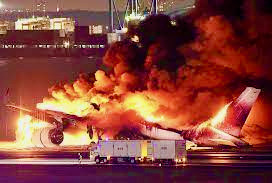 runway. All 367 passengers and 12 crew safely evacuated the A350-900’s burning wreckage further down 34 Right, escaping a smoke-filled cabin via inflatable slides (sans carry-on baggage) within 90 seconds, while five crew members aboard the exploded Bombardier Dash-8 perished; 14 were injured, including the coast-guard pilot. Issues: praise for JL516’s emergency procedures and the resilience of Airbus A350’s composite carbon fiber fuselage, the less combustable nature of its cabin furnishings. Concern for miscommunication between Haneda ATCs and Dash-8 crew, since the Japan Airlines jetliner was evidently cleared to land—not so the coast-guard plane.
Unease rose all the more as a passing Korean Air A330 plane soon kissed wings with a Cathay Pacific 737-300 being back towed upon a New Chitose Airport tarmac on Japan’s snowy Hokkaido Island. Then another 737, a Nippon Airways flight with 59 passengers and crew of six returned from Sapporo, Hokkaido to Tayana, Honshu with a cracking cockpit window across the outermost of four glass layers. No one was injured and the fissure affected neither flight control nor onboard pressurization, then again… (mmtc…)
Cold Sores.
Moreover, inflight turbulence, engine failures and massive birdstrikes plague air travel no end, as will white-knuckle takeoffs and hard landings, not to mention the troubling increase in such taxi/runway ‘close call’ incursions. Throw in over-taxed pilots (despite hefty pay raises) and a cold front of crew/stew labor strife (e.g., raising the mandatory pilot retirement age from 65 to 67); airlines coping with ‘guilt-free’ emissions pressures and tardy cleaner jet deliveries), not to mention scouring for bad or fake aircraft replacement parts. Then came Boeing’s recent door plug blow-out, which the FAA determined “…should never have happened…and cannot happen again.”
Hopefully some winter season modulation will serve to clear those cloudy holiday skies, defrosting the  bitter flight delays and cancellations—which were recently exemplified by Delta Airlines billeting stranded Amsterdam-Detroit passengers in a Goose-Bay, Labrador military barracks because of Airbus 330 icing problems.
What’s more, beyond the FAA’s air traffic control tower shortfalls, TSA checkpoint improvements under holiday duress is a warmly welcome balm to the chilblains of chaotic terminal congestion. Regardless of an ever looming threat of US government shutdowns, more efficient security screening promises to further ease our gateways in weeks and months to come.
Terror Firma?
Speaking of security, a New Years Eve specter of locked-down crowd control zones—product of bomb threats and other terror assessments—may have fizzled some of the celebratory sizzle. Yet no significant nightmare incidents were reported in cities worldwide. Still, we should remain mindful of extremist wartime hazards as we go with the floe, not to mention the return of masking in the face of resurgent respiratory viruses like RSV and new COVID strains.
Icebreaker: So cold-brewed strategies are now in order, including scouting out cheaper airfares in the months ahead (however whack-a-mole fleeting), even booking early for as far out as summer, 2024, also exploiting the post-pandemic economic pressures on high and/or low fare carriers. Being wary of dodgy  ‘all-you-can-fly deals, mileage reward roulette, shrinking frequent flyer miles, sticky hotel/lodging rates and such, not to mention airlines’ penchant for blitz-quick flight departure changes, or jettisoning flights and routes altogether with little or no notice. Nor will we wait idly by for Congress to act on predatory airfare spikes and crackdown on insidious junk fees.
Otherwise, this bracing winter season should help cool the holiday cabin fever in the skies, particularly soaring blow-ups in overstuffed airline seat rows—the overhead bin battles and territorial seat/tray skirmishes, much less the onboard food fights, stabbings, aisle scrums and pepper spray. Little wonder the FAA seeks more fines (up to $37k per incident/case) and criminal prosecution of passenger misbehavior  (over 270 cases filed since late 2021)—on everything from lav smoking to physical/sexual assaults. Ahh, holiday vamateur hour, au revoir…whether we’re staying on a snowy course or stealing away for the rays, spending winter on ice and the like.
Icebreaker: But pre-flight, we’re gonna continue working through, walking around stuffy, crowded airports, wary of creeping fees and the gouging gamut of retail/concession prices along interminable concourses, air ‘concierges’ notwithstanding. Moreover skirting the mayhem with due timing and patience—departure gates to baggage claim—even wheedling into luxury airline lounges, much like chaffering into luxe hotels when opportune. By the same token, tactics such as bag-fee angler vests and skiplagging warrant all due consideration.
On the technology front, computer snafus will still spark FAA tower/tarmac delays and aircraft ground stoppages, be it over software glitches or hardware malfunction, the EU and UK no less vulnerable to systemwide data/information breaches and crashes. New TSA scanners, lauded as more electronics and liquidity friendly, are still no match for crawling peak-period security lines, sluggish PreCheck, Clear of marginal help of late.
Updated data processing and procedures have not yet pared visa and passport application/issuance backlogs—Global Entry expedient efforts notwithstanding—while feds are accused of trolling subjects’ social media activity in US visa cases. Yet as techies say, a cold wave of almighty AI alchemy/salvation is well on the way…
Icebreaker: So we’ll still be combing, comparing and contrasting airline, lodging and third-party  ticket/reservation websites/mobile apps for deals and steals, for advantages and abuses—targeted to specific trips and itineraries—right down to paperless reservation/ticketing and baggage mishandling (Air Tags anyone?).
Also having focusing down cold on high-tech snafus and hacks, as well as transcending the toxins and pitfalls of T/T social media. Tracked as well will be the corporate consolidation and hi-jinx of flight/fare O.T.A giants like Expedia and Orbitz, as well as ancillary fee ‘unbundling’ and pay-per-reviews on too many carrier proprietary and middlin’ third-party booking/ consolidator sites alike.
Wintry Tooling, Railing and Sailing.
Same time, different station: 2023 train travel set new US passenger records, as Eurail ridership gained steady, heady steam across a sweltering continent. Moreover, AMTRAK is undergoing a systemwide makeover, gaining from a $1.4bn Congressional outlay for rail upgrades and repairs. Sleeker railcars, better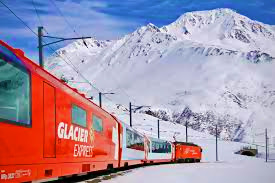 wifi: and that comes as higher speed rail advances, from Florida’s privatized BrightLine service to accelerated construction of a Las Vegas-to-Los Angeles leg, rail bed to station upgrades—eventually linking with California’s Central Valley HSR network.
Cruise lines enjoyed packed post-pandemic ships the world over, with bookings strong into the winter. This despite a destination backlash against bloated, floating city behemoths (e.g., limiting daily docking), reports of deck chair squatting, food/balcony straits, soused mateys overboarding guardrails into the deep, and coronavirus outbreaks revisited, not to mention a luxury MV Ocean Explorer ship stuck in Greenland mud. Still, some cruise industry heavyweights are floating new monster ‘utopian’ megaships and actually sailing toward private resort islands of their own (as on Carnival’s Celebration Key).
Cold Fuels.
Despite soaring gas ppgs, roadways were clogged all year round—cars, wagons, SUVs, camper vans, RVs  and motorcoaches taking to the highways in pre-pandemic numbers (even though bus lines like Greyhound are selling their venerable stations to realty vultures). But too often, it’s too many drivers to too few popular places: Traffic jams ruled the roads, no matter the inflated cost of buying and operating today’s techno-fiddly motor vehicles, much less motorcycles. For there are just too many more colorful winter joyrides to be so detoured or denied, and this promises to continue, despite snow stormy and black-icy conditions, particularly as gas prices keep trending downward.
Which nonetheless raises the matter of fossil fuel versus hybrid and electric power (with hydrogen fuel on the horizon). EV sales have increased dramatically, regardless of per-vehicle price tags, iffy driving range estimates, tech/software glitches, heavy battery fires—but mainly the equipment/deployment shortages of charging networks. Then come the issues of weighty vehicle traffic safety, let alone the prospect of more and more car shares and driverless vehicles—cabs, UberLyft, Amazon—on city streets, highways and byways. These concerns will soon be compounded with the takeoff of flying taxis (namely eVTOLs like Wisk Aero and Joby Aviation), WIG electric seagliders, shuttles, Google blimps and individual cars.
Icebreaker: So all modes and models will continue to be boarded, floated and/or taken for a spin with regard to comparative efficacy, service and safety…seeing to it we’re not derailed, waterlogged, backfiring or otherwise just plugging along as we go on our scenic winter drives.
Destination Desperation, Hot to Cold.
Clearly 2023’s post-pandemic ‘revenge’ tourism took its toll on destinations worldwide, overwhelming ‘hot spots’, domestic and international. Venice (struggling to fend off a total tourist takeover with entrance  fees), red-light Amsterdam and other popular ‘iceburg’ or sea ‘scape destinations establish visitation quotas, mount restriction bollards and selfie shields. But tourists still come and congest customary hubs the world over—with crime, hazards and worse awaiting them, or not far behind. Yet other, less traveled places and possibilities still struggle to regain their pre-COVID footing, not least Lahaina, Maui’s rebuilding tensity.
Hotel chains and other lodging logged record bookings in kind, with attendant rate raises, tightened cancellation policies, invasive ‘smart’ room surveillance, increased service abuses and guest complaints. While online share services like Verbo and HomeAway can be a consumer crapshoot, AirBnB posting the lion’s share of horror stories—stark, raving orgies to peeping toms—even triggering a New York City clampdown.
Parklands, preserves and heritage sites were overrun in 2023 as well, despite fire/smoke and flood threats —litter, vandalism, trespassing and landmark/monument desecration following in too many cases. Stricter reservation/allocation measures result in US national parks, from the Adirondacks, Big Bend and Everglades to Yellowstone and Yosemite.
In retrospect, last summer’s crowd muddle was perhaps best illustrated in Burning Man’s flash-flooded muck and mire across Nevada’s Black Rock Desert—a sea of Burners getting swamped and stalled in place for days. This, as Disney Corp. doubles down on pricing and expanding its plastic fantasyland in Orlando.
Icebreaker: So we’ll press on with exploring and fully experiencing winter trips, routes, settings, events and circumstances—little known local treasures to farther flung adventures; lesser travelled roads and beaten paths: insider secrets to whole other sides.
 Being mindful of potential crime and dangers therein. Shrewdly paring prices and skirting proscriptions when and where we may. Holding that Destination Dispersion, not hot-spot clotting is the better revenge, we will be toasting, sharing cold comfort food, hot adventures and Vamigré values via Club Vamaway before too terribly long…
More Cold Comforts.
All the same, topics of more personal nature are surely on the tray table. Flurrying into view are matters of traveler health and fitness, of reconciling work and travel, esp. remotely—as in carry-on bags versus checked luggage, what with the advent of more spacious Airspace L overhead bins. Or given everything, travel insurance: yea or nay? Add in affairs of spirituality and romance on the go—not to mention the spirits and substances that can help pave the way, as other issues snowfall in.
Now be VamoSure to keep eyes peeled for what’s to come—beyond the  splendiferous festivals, tourneys, meets and carnivals—seasoning to make for more venturesome, sun-splashed or cold-comfy and colorful.
Vambling through the whole winter wanderland—running hot or cold, if not just splitting the difference. That is, if you happen to catch our drift. (MTC…)
Travel’s In-or-Out Burger Archive…