
Vamobility: By All Means and Modes. 📌
(2/6/23)—To reiterate: It’s not just where we go, but how we get there. Planes, trains, buses and cruise ships barely scratch the surface, however, as Vamigré will also traffic in wheels within wheels (including choice, mean wheels), motors in perpetual motion, blades to the slopes and blacktop, pedals to the metal—with a  forward glance toward the frontiers of space and sky.
So under steady evaluation, rigorous comparison and contrasting, we will monitor all major travel modes and services, as well as minor and emerging means, according to our firmly established values and guidelines.
Among the ranks are (old and new) Vamobiles, VamoCycles, VamoScooters, VamoShips, VamoSpacecraft—anything cost-effectively enabling and benefiting Vamigrés in motion, with quality befitting The Traveler’s Vehicle…+ see what follows….
 Movement By All Means.
Gas, hybrid, electric: Vehicles’ engines/motors are running, wheels are turning—behold a range of modes/alternatives featured and vetted, for Vamigrés on the go, near and far—despite the increases in prices at the gas pump. Previews and reviews, pro and low-or-no rate, comparing and contrasting brands and marques, employing Vamigré standards of safety and performance. We will also be covering developments: perennial French railway strike shutdowns to transport advances to recalls to ‘road trip excursions’—even self-drivers (e.g., Tesla crashes), and flying cars… Please see Vamobility: Autos, Mini to Middi to Maxi…
VamoRailing and Roadways to Sea:
Don’t Go Sleepin’ On This Rocky Mountain Way.
8/28/21—That is, don’t overlook these majestic overlooks. For Canada’s travel award-winning Rocky Mountaineer scenic train lines rolled out its first US route August 15: a ‘Rockies to the Red Rocks’ excursion between Denver, Colorado and Moab, Utah.
The cushy two-day, one night run traverses those mighty Rocky Mountains, gracefully gliding down along the Colorado River through the canyons of Southern Utah. Imagine boarding this gourmet gravy train in Denver’s Union Pacific rail yard, climbing the Front Range around the ‘Big 10 Curve’ switchback, through Moffatt Tunnel and the Continental Divide up to some 9,240 feet.
Adventurous? You can brave the howling alpine winds on outdoor viewing platforms, getting high on the mountain splendor, smartphone photo snapping away. Then feed your more hedonistic vein by taking in all the lofty scenery from plush seating, through oversize clear-roof observation windows—or in a convivial 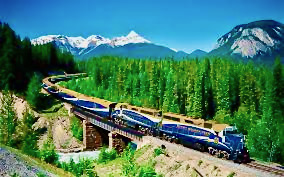 ‘lounge car’. Feast from a bountiful menu of regional food and beverages: If so inclined, dine on brazed prime cuts, bison or venison; savor seasonal vegetables and desserts from Aspen and other locales along the RtoR line. Toast the stunning scenery, the snow-capped peaks and mountains streams, with premium spirits, domestic wines and local craft brews. Meals and munchies are cordially served at your seat, which is equipped with a spacious individual tray table.
A Rocky Mountain High…
But you can hardly enjoy sites you can’t see, so about eight hours, 175 miles later, you descend between soaring canyon walls, through the White River National Forest and verdant valleys into Glenwood Springs. There you’ll spend the night in the Hotel Colorado, Hotel Denver or Hot Springs Resort, soaking up and/or soaking in Glenwood Springs, as the exclusively daylight train contains no sleeper cars per se.
Come morning, you will reboard the RtoR, which then begins a five-hour, 195 mile leg to Moab, Utah—Western Slope mountain forests giving way to red rock canyons and cliffs. Following the Colorado River through a Grand Valley chock with the green forest of 11,000-foot Grand Mesa, the train route affords stunning vistas of the buff sandstone of Book Cliffs Mountain Range. Along the way, you pass through Palisade, Colorado, with its Fruit & Wine Byway of beaucoup wineries and peach orchards.
Onward into Utah, past Book Cliffs and Arches National Park, the RtoR rolls through Castle Valley’s red sandstone bluffs, Rocky Mountains giving ground to a vast desert setting, into the trails and scalings, the rugged red rock arches and landscapes of Moab. Mountaineer train guides recommend, and can assist in arranging destination side trips fore and aft—including tour-partnered stops for the exploration of nearby areas, up and down the line.
...At a Rather Steeper Price.
Rockies to the Red Rocks itineraries begin in either direction, and offer SilverLeaf ($1,200+ per) and SilverLeaf Plus ($1,600+ per) classes (the latter affording exclusive access to the separate lounge). In either case, all 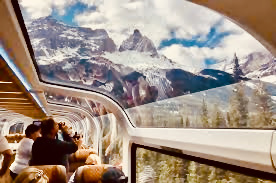 meals and drinks are included, as is the Glenwood Springs’ overnight hotel stay. Each comfortable seat is situated alongside those sky-high observation windows, every car featuring an outdoor viewing platform to trip on the magnificent mountains, minus any “rainin’ fire in the sky”.
In essence, RtoR provides everything you’ll need for a luxe, pampered rail cruise through some of the most spectacular mountain scenery the US has to offer—in the event that should be your thing wallet-wise.
Narrowing On An Alternative Route.
If not, you can always stoke your Rocky Mountain high on the historic Durango to Silverton Narrow Gauge steam train, 45 miles north to south through the scenic San Juan National Forest, finding a breathtakingly lower fare, at that. (MTC on this…)
Amtrak Derailed, Again?
Late 2019—Against public sentiment, Congress continues to place downward pressure on Amtrak, terming it a hopelessly money losing operation (claiming $3b/yr), budget squeezing or red pencilling it altogether. Mainly Republicans cite slower, less reliable service and breakdowns of aging rolling stock, save for the congested Northeast corridor.
Threatened as well, perhaps fatally so, are extended route, long-run trains (750+ miles), such as the California Zephyr, Coast Starlight, Empire Builder and Chicago-New York Lake Shore Limited. The latest Amtrak thinking is more frequent service to more cities, albeit over shorter distances (MTC on all this).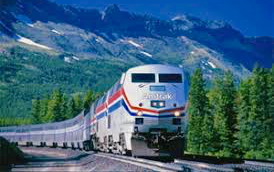
The intent: once again scaling back the national network, in the face of: Growing popular support nationwide, a brand new ‘All Aboard Florida’ train connecting Miami and Orlando. New light-rail services in Portland, Denver and LA Metro’s Gold Line—with a renewed North Bay light-rail roll-out in Marin County, California, despite local light-rail snafus like Honolulu’s.
While prospects for high-speed rail service between the Bay Area and LA, Chicago to St. Louis advance with new enviro hi-tech equipment, shovel ready routing and increased state state/Federal funding (e.g., for CalTrain electrification).
Still, much remains to be done here: beginning with the infrastructure improvement of road/railbeds to prevent these faster trains from suffering wreckage/accidents the likes of Egypt or India—beginning with the broad implementation of Positive Train Control (PTC). However, it now appears that many commuter and passenger lines across the country are requesting two-year extensions to the nationwide December 31, 2018 deadline for that very installation.
They cite PTC technology bottlenecks due to too few suppliers, and that the system requires extensive coordination among track/roadbeds owned by an array of predominantly freight railroad companies. Involved are laying trackside detectors, putting up electric wires, wireless radio towers and networking GPS monitors to testing and fine-tuning PTC’s automatic braking and acceleration. While slow Congressional action and oversight is in no way helping to speed up this mandated process—which even the NTSB warns is no end-all, be-all safety attribute in and of itself.
Proof Positive.
No better instance of PTC’s need, not least its authentic braking system, and how it can slowdown or stop a train under conditions of signal failure, than was Amtrak 91.
Southbound through Cayce, South Carolina, the Silver Star train entered ‘dark territory’: the route’s electrical signal system gone out of service. Track workers were charged with manually turning 40 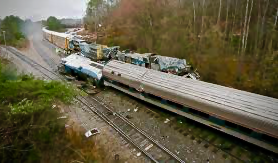 switches, but one main line re-router was erroneously left unflipped, pointing rail traffic in the wrong direction. Tragically, Amtrak 91 slammed directly into a sidetracked CSX freight train, crushing the passenger liner’s engine unit, killing its engineer and conductor.
Again, the PTC mandate is now some ten years old, a 2018 deadline well past, now pushed back to 2020, and its full compliance drags on and out. The NTSB still pushes the Federal Railway Administration (FRA) to complete the PTC technology’s implementation nationwide. But the industry blames software glitches, track incompatibilities and the $10b-14b cost.
Meanwhile, trains, freight and passenger, keep running at cross purposes and behind, on rails that get more and more crowded and corroded by the day. At persistent issue is the enforcement of a federal law that gives passenger trains preference over freights, however the Association of American Railroads counters that passenger service riding freight rails should not impede the safe, timely flow of the nation’s goods. Also unresolved is a Congressional law mandating the establishment of on-time performance standards for both parties, which the AAR is now appealing in the courts. Still, Amtrak maintains that train travel is safer and speedier than ever, however lacking in seatbelt/harnesses and fortified windows.
Moreover, exacting crew sleep and drug/alcohol tests must be furthered by the FRA and NTSB to eliminate the risk of Amtrak crashes such as Philadelphia’s speeding curve wreck and Washington state’s derailment and tinny Talgo traincars’ overpass plunge (by Amtrak 501) on a hazardous 80 mph to 30 mph curve (which the NTSB has determined involved lack of PTC and excessive velocity due to operator error and “Titanic-like complacency” all around). A recent Amtrak inspector general probe found rampant slipshod drug/alcohol screening for thousands of its ‘safety sensitive’ employees—even in this opioid era. More broadly, rail service must contend with inevitable labor strikes (e.g., France and Germany) at crunching, inopportune times. Or British Rail’s unending apologies for its service/scheduling woes.
But most importantly, careful watch must be kept over the current administration’s D.O.T.—especially Transportation Secretary, Elaine Chao, who is under constant Republican-led pressure to cut budgets and costs at every turn, to railroad Amtrak and other lines into oblivion…
RE: Iconic Rail Routes in More Debt and Doubt.
Debate on the system looms anew, as Congress will be reviewing a fresh five-year assessment-management plan, and the U.S. national rail network will once again be getting slAMTRAKed all around.
In essence, the new Amtrak vision is reportedly to wean itself from many legacy long-haul routes in favor of increased short-haul city-to-city service along more densely populous commercial corridors, particularly in southern and western states. That implies shedding, or at least dismembering the likes of the California Zephyr, Empire Builder, City of New Orleans and Southwest Chief—a Sunset Limited amputation, to say the least.
Sky-High Motivations? The Long and Short of It.
Current Amtrak CEO, Richard Anderson (a former Delta Air Lines honcho, no less) claims that “the demand is clear for additional short-corridor service”; that “the present network simply does not fit the future.” Then come the hard realroad 2018 figures: Long-distance ridership down slightly to about 4.5 million passengers, with an adjusted operational loss of $543m, as compared to the $524m yield from the Northeast Corridor alone. This, on a Congressionally allotted annual budget of roughly $1.9b, as opposed to $3b for airports and $45b for highway construction.
Anderson’s crew goes on to assess the need to replace the system’s aging long-distance trains. The projected Amtrak budget will require $2.2b to $2.7b through 2030 (of a total cost of $3.8b) to replace the aging long-haul rolling stock, new engines included. Among allocation decisions will be whether to order modernized dining, sleeping and baggage cars, or units better designed for serving shorter (more intercity) route passengers.
More is Less?
Sounds like glorified stretch commuter trains, but current Amtrak management maintains that distant city network web operations could be reworked into multiple trains running truncated sections of longer routes on a point-to-point basis, rather than the more utilized and Euro-efficient web network. Moreover that longer distance route passengers tend to be older—more leisurely vacationers than on teeming, time sensitive Northeast Corridor expresses—those who could weather the inconvenience of increased train transferring, anyway.
Yeah, so? The former are paying riders, as well—15% of Amtrak’s over 31m yearly riders, but strong 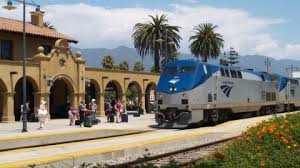 advocates for the country’s classic interregional, transcontinental trains, and won’t give them up without a bruising battle. Besides, the freight lines that own the rails Amtrak rides on are not too keen on accommodating even more (short-run) passenger trains on their already overused tracks, while passenger rail advocates consider the congestion and delays ‘freight train interference’.
In any case, Amtrak says that such “…study and planning isn’t done yet, and we aren’t prepared to announce or recommendations yet, (which) will come in our reauthorization proposal.” At that point, Congress will be the semaphore, once more struggling to balance a history of defending Amtrak’s long-haul routes (across constituent territories) with improving its financial performance.
 Otherwise, it will likely continue to shed routes, much as it is the ‘Hoosier State’ limited train from Chicago to Indianapolis (on June 30)—leaving the territory to the likes of OurBus, a higher-end city-to-city operation with plush seating and WiFi moving its strong east coast presence into the midwest via fuller, flexible scheduling and dynamic fares. What with established service by Greyhound and Megabus, chances are Amtrak will never ride the Chi-Indy rails again. (See below…☟)
So Vamigré will be watching with third rail vengeance either way…even to the point of historic train station regeneration and ‘Yachts on Wheels’ extremes…Destination Dispersion, powerfully trained, cowcatcher to caboose, as it were…

Is Amtrak Getting SlAmtraked?
High-Speed Rail: Train to Knowhere, Fast…
Train ’Necks & Wrecks.
By the way, it’s hard to tell which recent rail mishap was more bizarre, the Egyptian conductor slam, or a branching-out, bottleneck snow job:
Ambushed Along an Oregon Trail.
Go figure this showdown in longbranch country: A Sunday morning train leaves Seattle’s towering King Street Station right on time. The Amtrak Coast Starlight soon accelerates southward past SeaTac and Olympia under sunbreak skies, seldom seen ground-level snow patches along either side of the Puget Sound right of railroad way.
Coach cars packed, over 200 passengers settling in for the long haul—staking out territory row by row, stuffing personals in overheads and under chairs. Riders of all sorts and ages, adjusted seating, breaking out juices and snacks—craning for a view of cloudy Mt. Ranier, otherwise watching rural Washington barnyards and hay bales whizz on by.
Rolling through Portland, Train 11 adds passengers along the way. Its café car is already abustle, rolling with the brunch and lunch crowd, punching their devices or playing cards, sitting into cross-table clutches to share travel tips and tales—many deliciously envisaging sunny southern California. The ride from Salem 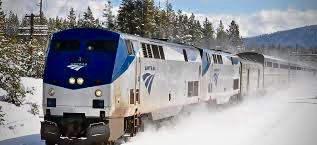 beyond Eugene is a winter wonderland of wooded hills, scenic tunnels and storybook whistle-stop towns blanketed in heavy rain turned snow.
Then comes the village of Oakridge, 45 miles southeast of Eugene, hard up into Willamette National Forest, and a nearby low-hanging tree branch further weighted down with snowcover. By about 6:20 p.m., the Starlight tangles with that heavy limb, which had now actually fallen onto the Union Pacific tracks, effectively blocking the Amtrak train from any further southward progress.
Hassle enough—with the conductor announcing that ‘it was going to be a slow go from here’ over the cabin loudspeakers. So, what to do but deboard into Oakridge until the tracks are cleared of trees and snow. Except crew and riders alike discover that the train is now surrounded by mounting drifts, trapped amid Oregon’s atypical winter splendor, burrowed into snow depth unwitnessed hereabouts in years.
Not that it matters much, because Oakridge itself is similarly isolated, having lost electrical power and being snowed in, the town essentially shutdown. So reality bites: a trainload (of some 200 people) is stuck in timber country, with no ready way out. But how long could it take to move a tree branch, right? Just call in the U.P line workers, or local lumberjacks and their chainsaws…
Bushwhacked and Bereft.
Uh-huh, well, keep the faith. In the meantime, however, the train crew keeps everyone ‘safely’ onboard due to the threatening weather conditions, much less the prospect of passengers scattering to Oakridge’s two small, powerless hotels. Moreover the Starlight could be set free at any time. Rather, Amtrak assures riders that Train 11 has ample heat, food and water on board until then—which would be available free of charge.
In the meantime, restive passengers begin pounding on railcar windows to get out, getting claustrophobic as the hours wore on. Attitudes and approaches range from funny raillery and friendly cooperation to fussing, feuding and panic attacks. Commotion increases over norms, boundaries and territorial claims. Stalled riders gather to solve problems practical in nature; others squabble over degrees of personal comfort and inconvenience. Aging hotheads and fitful toddlers storm the aisles.
Provisions gradually run out, opened carry-ons tumble out of overhead racks and spill from under seat rows. Refuse and garbage begin to pile up, diapers are in short supply and clogged toilets begin to run over.
Goodwill erodes as tempers flare, sleep is disrupted by roving shouting matches, tribes are forming 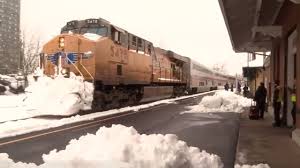 through the railcars. Cellphone bars tail off, batteries die, social media and apps fall off with any common sense of patience and calm, or with any hopes for a rapid resumption of through service to sunny California. As Train 11 doesn’t budge an inch.
The Little Engine That Couldn’t.
’Twas nearly 40 hours before another, U.P. locomotive arrives from up north to tow the entire Coast Starlight train out of the blockage and, of all places, back to Seattle—right where this disjointed journey began days before. Amtrak officials warn of ‘further delays and cancellations because of uncertain weather conditions’, and announce that they will contact Train 11 passengers “to provide refunds and other compensate as appropriate.”
Vamigré will see to that, meanwhile remaining soaked or shoveling in Seattle, to keep dreaming that sunny, Starlight California dream in King Street Station…as if none of this ever really befell us along a snowy Oregon Trail.
Egyptian Trainspatting.
How two conductors could leave their controls of a speeding train to throw hands is bizarre enough. That the fight resulted in a runaway locomotive crashing into a crowded railway station is a disaster movie scenario.
Yet an Egyptian train crew did just that, causing a single unmanned locomotive/railcar to head-on ram a concrete and steel buffer barrier in Cairo’s main Ramses Station, engulfing terminal patrons and passengers in a fiery explosion.
More than 25 people perished, some 47 more were injured in the smoke and flames. Apparently the conductor (who survived the crash) of the lead locomotive left his post without setting his railcar’s brakes. 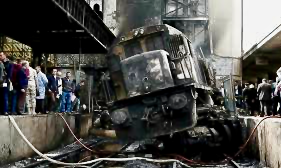 He proceeded to the rear car to tussle with its conductor. That car began rolling backward, which freed the locomotive to race toward the station’s barrier at track’s end.
The State Railway Agency stopped all train traffic and ordered the station’s evacuation. Investigators have interrogated the locomotive driver/conductor, and Egypt’s Transportation Minister resigned his post.
The country’s government had already been blamed for neglecting Egypt’s cash-starved railway services. The system has long been plagued by poor management and woefully maintained running stock and rail line equipment. Records reveal nearly 1,800 train accidents across Egypt in 2017 alone.
Fortunately, none were as deadly as the fiery 2002 crash, killing more than 300 on a train speeding from Cairo to southern Egypt.
Small comfort, there. Here’s hoping the combative conductors have settled their beef…
Fuss With The Bus?
10/22/21—The ‘Hound’ getting grayer and grayer, Dallas-based Greyhound Lines, Inc. has recently changed masters. Its new leash on life comes to the largest US intercity bus operation via the purchase of the nearly 107-year-old company by a German-owned motor coach behemoth,FlixMobility GmbH has bought the Greyhound system from FirstGroup PLC—the British transit outfit that has run the bus ops since 2007—for $172m; it will also lease Greyhound’s real estate properties from FirstGroup.
The Dallas-based line carries some 16m passengers to 2,400 destinations, but has ill-delivered for ages. FlixMobility executives believe “North American (travelers) seek smart, safe, comfortable and affordable transit alternatives” to (fuel) costly private vehicles. The German company itself, founded in 2013, currently covers over 2,500 destinations in 36 other countries,
So Vamigré will see if that old dog can now hunt and haul ass better in the US than Greyhound has for decades on end.
As to past troubles, the terror of a Greyhound driver throat slitting and fatal bus crash illustrates that highway travel has perils of its own. The most recent fatal mishap involved a head-on collision outside Thoreau, New Mexico (some 100 miles west-northwest of Albuquerque), wherein a semitractor-trailor apparently blew a front tire and veered into an oncoming Greyhound bus carrying a driver and 47 passengers. The impact sheared off the front and driver’s side of the westbound coach, killing the operator and at least eight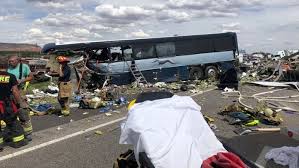 passengers from blunt force trauma, leaving frightful debris scattered across the highway and median strip.
Local and NTSB investigators have now removed mandated electronic logging components from both vehicles and the truck’s front tires, sending them to Washington for analysis. As often happens, the precipitating truck driver of the Fresno, California-based semi survived with non-life-threatening injuries, while his employer’s fleet safety record is spotty and under further scrutiny—too far after the fact…
Greyhound Too: Heard It Through the Grapevine (2/6/20).
Rapid gunfire, dark cramped cabin, 1:28 a.m.
It is said that “everyone has a terrifying Greyhound story.”
But for the 43 riders on bus No. 6848-1 February 3, a trip became terrifyingly fatal. The red-eye coach was bound for San Francisco from downtown Los Angeles via Interstate 5—fully loaded, with a passenger age range of 19 to the elderly, including youngsters ages three and four.
By the time 6848-1 neared California’s Grapevine, a dispute over seating and disruptive noise turned deadly. A cursing and incoherent muttering 33-year-old man from Maryland 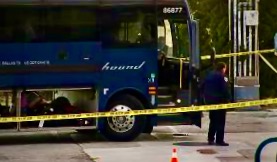 named Anthony Devante Williams began shouting expletives at a fellow rider asking him to quiet down. A fight ensued, Williams pulled a revolver and started shooting about the darkened cabin, firing eight or nine times.
Passengers ducked for cover, crouched heads down in the darkness—suddenly trapped in this rolling shooting gallery. A 51-year-old woman perished; the wounded were women ages 19 (critically), 39 and 50, men 45 (critically) and 50 years old.
Several heroic passengers finally tackled and disarmed the shooter. Greyhound’s driver steered over roadside at Fort Tejon, where Williams deboarded the bus, leaving his 9mm semi-automatic pistol and some ammo magazines on his seat. The coach then turned off I-5 onto the Grapevine Road exit in Kern County.
An immediate gas station stop enabled emergency officials to first-aid assist the victims, 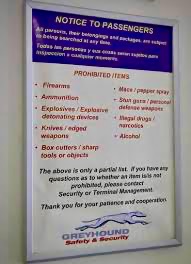 while police officers arrested the gunman along an I-5 shoulder on murder charges, and federal ATF inspectors and other agencies swarmed the scene.
Some shaken passengers continued on in another bus to an early morning San Francisco arrival; others found alternate transportation. Greyhound supervisors did their obligatory ‘thoughts and prayers’, and pledged to assist the incident’s myriad investigations.
Yet a critical question remained: What about the the bus line’s meager route security efforts? Particularly when many of its passengers have so little other consumer choice or power.
Some of those 6848-1 riders called for stricter TSA-like baggage searches, even onboard security guards (sky marshal style), at least on longer overnight runs. This becomes particularly topical now that the nation’s largest bus company is grappling with warrantless ICE/Border Patrol immigration checks and sweeps, which impede coaches and otherwise inconvenience its passengers, if not running afoul of their Fourth Amendment Constitutional rights. But it looks as though the bus line has since legally prevailed on that score.
Thus on these and other issues, Vamigré will make sure Greyhound hears about it through the grapevine—from I-5 to I-95—and everywhere in between. (MTC…)
Similarly, another recent bus crash: A motor coach killing at least 28 of 55 passengers, mostly German tourists—is a further cautionary tale. Local authorities say the driver lost control of his bus at a junction near Canico on the Portuguese island of Madeira, rolling down a steep hillside into several houses. Did his brakes fail? Was he speeding, on substances, or negligently taking in the view? Only time and investigations will tell—again, likely much further down the road.
Yet domestic short and long-haul bus service carries deeper problems: lax safety (say, regarding seatbelts/harnesses and reinforced windows) , runaway tour buses; random police searches, disgruntled, fatigued drivers; unappealing terminals, overloaded, unruly  cabins; wayward itineraries and distasteful rest stops—even on the most pleasantly scenic routes. Sadly, the TSA’s station security measures will do little to enhance this experience. Problem is, image-buffed Greyhound still has a firm grip on U.S. Routes and lowest-cost travel, save Megabus or Redbus, with little motivation to improve its service/security absent concerted passenger pressure. Such consumer activism (beyond toothless Trip Advisor rants) must begin with a demand for more regional alternatives (to overtaxed municipal bus operations and ticket/class stratification. Ergo a speedier, less congested, better served option in plusher coaches. Attractive routes with quality food, stops, Wifi: a premium service alternative to old smoky curbside carriers and hassle-jammed airplanes.
Cruising for a Bruising?
Update: COVID-19—Seasickness and Cruisifiction.
Here we will cover onboard illnesses, outbreaks, food poisoning and overboarding. Then come drunken dunking into stormy seas, and fatal rogue wave slamming between Antarctica and Tierra del Fuego. Or the latest funny business (3/6/23)—namely the recent ‘suspicious’ death of a woman passenger on a Carnival Cruise Liner. Stewards on the good ship, ’Sunshine’, sailing off from Charleston, South Carolina to Nassau, Bahamas, found her lifeless body: circumstances surrounding which her husband had no immediate explanation A sudden illness? Neither he nor any passengers were so affected or threatened, and the FBI is currently investigating. (MTC…)
🛳 Crucibles Of the Cruisaders.
Recent images of cruise liners in Miami virtually drydocked like mothballed WWII troop ships bear out an industry that has been taking on water for months on end.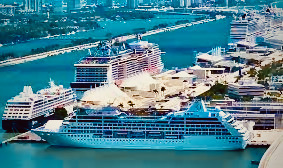
Why South Coast Florida? Because with COVID-Omicron still raging, Caribbean island hotspots such as Aruba, Bonaire, Curacao and Puerto Rico continue denying entry to cruise ship traffic. This untimely wave-season anchoring typifies the dire straits the beleaguered industry is navigating these days.
COVID outbreaks, passengers and crews sickened, ships quarantined, voyages scuttled, and/or turning around: little wonder bookings have slowed, down by upwards of 25%—or that cruise lines like Norwegian and Royal Caribbean are postponing halting even popular cruises, some cancellations extending into April. Moreover continued CDC warnings against cruise travel aren’t exactly serving as a lifebuoy.
Nevertheless, operators such as Carnival contend that “capacity is coming back strongly, mainly with repeat cruisers…(and) there is a lot of pent-up demand.” They point to strict adherence to COVID-19/Omicron rules regarding vaccinations (including boosters), masking, testing and onboard medical capacities. That shipboard coronavirus cases are now in the “minority” and resulting hospitalizations are “minimal”—making their ships “the safest vacation environment today.”
Given the ‘cruisaders’ desperation to rebound from a rough sea of revenue losses and corporate debt, nothing short of such buoyant messaging and beaucoup sales (much less generous refunds and future 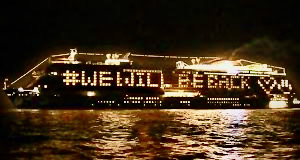 credits) are likely to rescue them. Still, with so many people packed closely for long stretches at sea, some of whom are ignoring masking rules, wildfire transmission and onboard isolation may continue to shanghai vacation/travel plans.
Let alone when seafaring tales such as the Crystal and Star Cruises’ crucible go viral. Case in point: the Crystal Symphony ‘brokeout’ of Miami January 8, bound for the Caribbean with about 300 passengers and 400 crew, and had set sail for a Florida return after a two-week cruise when it suddenly became something of a ‘pirate’ ship, tacking to the Bahamas as a means of avoiding seizure. Seems a federal judge had issued an arrest warrant for the luxury liner, meaning a US marshal would take control of the vessel once it re-entered US waters because Peninsula Petroleum Far East had filed suit against the cruise line for $4.6m in unpaid fuel bills.
So after spending a Saturday night docked in Bimini, passengers and crew were flown back to Miami on Crystal’s dime. A line spokesperson said, “This end to the cruise was not the conclusion to our guests’ vacation we originally planned for…due to non-technical reasons.” The Cruise Lines International Association (CLIA) further acknowledged, “Ships turned around at the last minute have a negative impact on passengers…”
Call it seasickness of a dodgiest kind. Otherwise, the cruise industry can only hope that shrinking trips don’t sink ships, far and wide. (MTC…)
More broadly, take cruise ships to lake ferries and riverboats—including the Northern Passages, down to the horrifically fatal ferry capsizes, Lake Victoria to Indonesia, and overcrowded tourist boat crashes netting 28 sightseer fatalities and the 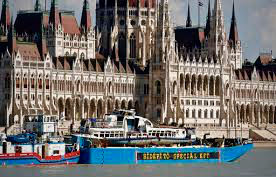 Danube blues.
On the latter, it was an international Viking Sigyn longship—a floating hotel, really, nearly 450-feet long—ramming, sinking a 89-foot local sightseeing ‘Mermaid’ boat near the Hungarian capital’s Margaret Bridge. The collision occurred on a rainy Budapest night May 29, along a river running high and hard. Sprinkle in transport barges, dock in permanent restaurants and other glutsy visitor attractions, and the 1,800-mile-long Danube hits a monumental choke point thereabouts—crowded in by the Chain Bridge, Buda Castle and the imperial grandeur of Hungary’s Parliament building.
Sigyn’s captain has been charged with gross negligence, with questions swirling about why the 64-year-old, 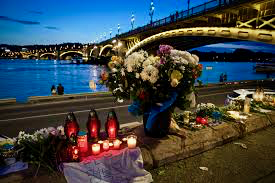 multiply reproved Ukrainian was helming one of Viking’s newest, largest vessels. But a more troubling issue is the traffic slog on this stretch of the majestic, mutable Danube River. Again, too much congestion/ too tight spaces (Destination Dispersion, hello...) collides with the diktats of a tourism-bound economy: namely, profit over safety concerns at all costs.
Then there’s the most recent cruise ship behemoth, MSC Opera crashing into a far smaller tourist boat docked in Venice’s narrow Giudecca Canal—near the fabled lagoon city’s popular St. Mark’s Square—shoehorning out-of-control into the San Basilio Terminal wharf.
Along with megaship port overcrowding and Caribbean, Mediterranean clogging—namely, those bloated boat ‘Cities on the Sea’ like Carnival’s AIDAnova—comes the discharge, sewage polluting the seas. Carnival Corporation was in fact just fined a $20m dumping penalty by the U.S. Justice Department for fouling the seas with ‘gray water’ discharge and worse, then falsifying records about it. Carnival’s Princess subsidiary had already paid some $40m in fines, as its liners were in essence caught trashing the “very environment in which it navigates for profit” in 2016—another in a series of felonious penalties dating back to 2005. 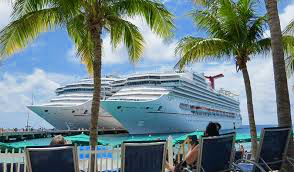
Also, the everpresent spectre of pirate overtaking, and kidnap, ransom attacks. Lest we forget the relative lawlessness in international waters: that gray area of crimes committed at sea without defined police jurisdiction—even going overboard with disappearances, left to onboard security services under cruise line employ, hesitant to make PR waves, whether the situation warrants investigation or not.
Cruise Decontrol.
The imminent launch of several ’boutique’ cruise ships heralds a hale and welcome fleet of unique voyages, in a sea of ever larger, bloated ‘citiboats’.
Select excursions range from a modernized 19th century riverboat steamin’ down the ol’ Mississippi (americancruiselines.com), to a choice ‘armchair’ adventure on the Scenic Eclipse, down through Patagonia and Antarctica—equipped with helicopters and a seven-passenger submarine (scenicusa.com). Which raises the question: are these truly vacations or comfy va-simulations of same?
Indeed, whale lookyloo in luxury aboard a 92-cabin Le Bougainville Ponant liner, which features an 8-foot 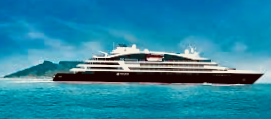 underwater salon, sailing along the coasts (or coral reefs) of Zanzibar, Tanzania and the Seychelles (en.ponant.com). Maybe eco-venture to the Galapagos on a 142-foot-long yacht outfitted with paddle boards, kayaks and diving gear for individualized side treks to explore these islands’ phenomenal natural and evolutionary/zoological wonders (ecoventura.com).
Then there comes Hurtigruten’s MS Roald Amundsen, a Norwegian hybrid fueled by liquefied biogas that cruises pole to pole, and to Scandian and lower European ports in between—offering hot tubs and an infinity pool to keep active, sporty, environmentally woke travelers comfortably warm and/or cool, as climes allow, details at (hurtigruten.com).
🛳 One Singularly Chilling Seascrape.
Better that than lamely lemming onto a ‘citi-ship’ like the Viking Sky, which recently broke down off the Norwegian coastline in frigid, notoriously treacherous waters. The multi-deck, nearly 48,000-ton cruiser, bound for England’s River Thames, developed engine trouble in stormy 38 knot winds and 26-foot waves, stranding 1,300 people 2.5 nautical miles from the western Norway town of Molde.
“The thing was rocking and rolling in the big waves,” said one rescued passenger. “Closet doors were banging back and forth—furniture, glassware, everything was breaking. People were sliding across the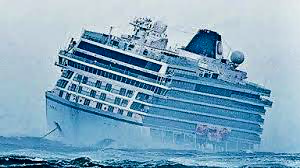 decks.”
This, after drifting into Hustadvika Bay, Viking Sky’s mayday distress signal and long, harrowing hours of evacuation. Terrified passengers in fluorescent life jackets waited patiently as five helicopters and several violently heaving rescue ships lifted several hundred stranded travelers from the ship’s decks to safety in Molde.
The crew was eventually able to restart one of their Sky’s engines—just in time, as the ship risked being thrust and grounded onto the rocky Norwegian coast. It eventually headed to shore on three of four engines, at a crippled speed of 8 knots.
Viking Cruises, headquartered in Switzerland, listed some 20 injured in the 24-hour ordeal: passengers from the U.S., Canada, Britain—and as far away as New Zealand and Australia. Mostly ‘elderly’, they suffered cuts, bruises, some broken bones and their share of PTSD (passenger travel seasickened distress)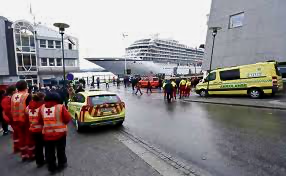 .
.
Viking stated that this was “among the worst incidents the cruise line had ever experienced”, that the passengers would be flown home and (‘money back’) compensated. The Sky itself was detained in Molde for full investigation of its engine failures.
Still, no one-off here: The cruise ship industry has not been sailing free of at-sea or port disasters in past years—not least onboard fires, illness epidemics and food poisoning—which render many of these vessels to be little more than ‘cruisinarts’ of sea-bound diseases.
So the Vamigré credo remains, No ships ahooey, and don’t you let cruisers be for losers in their Speedos alone…
Above and Beyond.
Moreover, coverage of private aircraft and sea craft to embark in all due time..including ‘hydro-trains’ and the growing proliferation of small-craft VLJ’s, not least (Boeing subsidiary) Aurora Fight Science’s eVtol—the Blackfly, Volocopter and Cora flying taxis, or Terrafugia, Uber and Hover-Bike, flying cars! Even vertiports (e.g., rooftop Skyports), which would provide landing, recharging and other servicing—in anticipation of the onset/launch of autonomous passenger-carrying drones. (MTC…)

