


Previous Story
Federal Offenses: T.S.A., D.O.T., F.A.A, N.T.S.B.📌📌
Posted On 02 Feb 2019
Comment: 0
Pilot Frights.
(8/16/23)—The latest in cockpit calamities: The right engine of a Southwest Flt. 307 bound for Cancun from flamed out shortly after take0ff August 11, returning to Houston’ Hobby Airport . This after another SWA 737, Flt. 2493 aborted its takeoff from San Diego International Airport August 14, upon finding that a private Cessna 560X had already been cleared to land on the same runway, whereby the errant ATC urgently called off the business jet’s descent within 100 feet of Runway 27. The Southwest flight eventually departed for San Jose, while the FAA is said to be investigating this most recent ‘go-around’ to get around an incursive disaster.
An even closer call was the August 15 medical emergency aboard LATAM Airlines’ LA 505 from Miami to Santiago, Chile with 271 passengers on board. The captain, a 27-year veteran of the skies, apparently took ill in a forward restroom barely three hours into the flight, passing away before the remaining crew could divert the 787-9 Dreamliner safely to Panama City. Pilot incapacitation at the helm: another scary inflight nightmare, to be sure.
Nearer the ground, Alaska Airlines Flight 369, a 737 MAX-9 bound for Seattle from Nashville, Tennessee September 12 had to abort takeoff at nearly 120 m.p.h. to avoid Southwest Airlines Flight 2029, a 737-700 mistakenly cleared to cross its runway—369’s brakes overheating, landing gear tires blowing up. Not to mention its passengers’ systolics and diastolics. (MTC…)
WingDing au Deux.
(2/15/23)—Following far too closely for comfort in the wake of that JetBlue flight nicking a nearby airliner on departure from JFK ☟, United Airlines Flight 2135 to Orlando did the latest wing-clip job today on a neighboring jetliner. In this case, UAL’s 757-200 was taxiing away from the gate at Newark Liberty International Airport. Then comes the shuttle bus giving a towed American Airlines A321 jetliner something of a little nose job in a ‘low-speed collision’ at LAX, injuring five. In its wake, reports are a taxiing United Airlines 777 ’heavy’ jetliner nearly crossed runway paths with a landing Kamaka Air Cessna 208B Super Cargomaster at Honolulu’s Daniel K. Inouye International Airport on January 23—seems like a ‘close-call virus’ is spreading by land and air…
The latest incident being at Hollywood-Burbank Airport (2/22/23) where a landing Mesa Airlines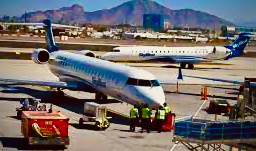 CRJ900 did a sudden pilot-initiated climb-out to avoid a Sky West Airlines Embraer E75 taking off from the very same runway. Mesa’s landing aborted, the Sky West plane continued its departure—albeit with a (Bob) Hope and a prayer, given that this was the 4th such near miss already this year.
Mere days later, another near miss, this time at Boston’s Logan Airport. Early Monday evening (2/27/23), a landing JetBlue E190 had to initiate an evasive climb-out action to avoid a Lear Jet 60 rolling out without clearance on intersecting Runway 9. JetBlue Flight 206’s ‘go-around’ tacked nearly 15 minutes onto the Nashville run, before landing without further incident on RWY 4A. No injuries, no aircraft damage reported: the FAA and NTSB investigate yet again, their many retirements, other staff shortages in the crosshairs.
Tower Vacuum.
(2/10/23)—Closer yet comes the brain fart of an air traffic controller at Austin-Bergstrom International Airport Saturday morning that had a Southwest Airlines 737 bound for Cancun cleared to takeoff on Runway 18 Left. Problem was, a FedEx 767 cargo jet was cleared for landing mere moments earlier 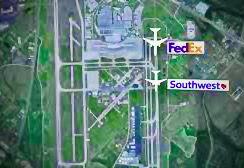 on…Runway 18 Left. With the freighter ATC-directed to all but piggy back the accelerating SWA passenger plane from some three miles out, sanity radioed in and the cargo crew aborted its landing at barely 75-foot altitude. As it happened, the 767 ‘heavy’ came within 1,000 feet of SWA’s ass end, suddenly climbing less than 100 feet above the 737, narrowly avoiding a disastrous runway collision.
SWA Flight 708 safely completed its takeoff to Mexico as the freighter peeled away to its left, circling to land strictly solo 12 minutes later. Aviation observers attribute this empty-headed tower instruction to an ever increasing pace of airport operations, too-often overwhelming ATCs. While the National Transportation Safety Board (NTSB) has initiated its investigation of this latest close-shave overflying incident—sifting through the granular data, as it were. Given that the FAA has logged 14 such ‘close calls’ over the past decade, Vamigré to crews and towers: You have to quit meeting like this, over…(MTC…)
Canary In a Cold Mind.
✈️ Update (2/11/23)—Since having resisted testifying at this NTSB probe, the three American Airlines pilots involved in the JFK ‘close call’ (see below) have since been subpoenaed to appear before the board within seven days for audio recorded/court reporter transcribed interviews, which Air Line Pilots Association (ALPA) union reps are challenging as unnecessary and unfair, particularly the video part. Likely at issue is the American 777 crew’s disobeying an ATC directive to turn right and cross Runway 31L, instead bearing left, straight across toward 4L in front of Delta’s speeding 737—a ‘possible pilot deviation’—until controllers emphatically ordered the heavy A/A jet to hold short and Delta to ‘cancel its takeoff clearance’ on 4L. (MTC…) ☟
(1/19/23)—Chills ran rampant once news of a near collision last week, when two jetliners came close to crossing paths on John F. Kennedy International Airport taxiways and runways, missing one another by barely 1,000 feet.
Delta Airlines Flight 1943, a 737-900ER bound for Santo Domingo, Dominican Republic with 145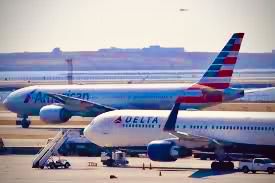 passengers +crew had just been cleared for takeoff. While an American Airlines Flight 106, a 777-200ER headed on a daily New York-to-London trip with 137 onboard, was taxiing out, ultimately to line up behind Delta 1943 on Runway 4 Left at about 8:45 p.m.. But that was where the tack turned.
Misdirection Misplay.
Left, right, left, right? Wrong. But first, no sparing the details:
According to airport tape transcripts, Kennedy Ground Control had instructed A/A 106 Heavy (large) to depart the gate, beginning a counter-clockwise taxi route from the Tango Alpha (TA) intersection, paralleling Runway 31 Left to Taxiway Bravo, then hold short of Kilo. At the time, Delta 1943 was waiting to takeoff on Runway 4L, which happened to intersect 31L roughly one-third the way down.
A/A 106 had been directed by Kennedy Tower to turn right and cross 31L at Taxiway Kilo to Juliet, en route to takeoff on 4L. That was precisely where Delta 1943 had just been cleared by Kennedy Tower Control for departure, pilots pushing throttles to full power.
Problem was, the American 777 crew did not turn right to cross 31L as directed, despite having ‘rogered’ 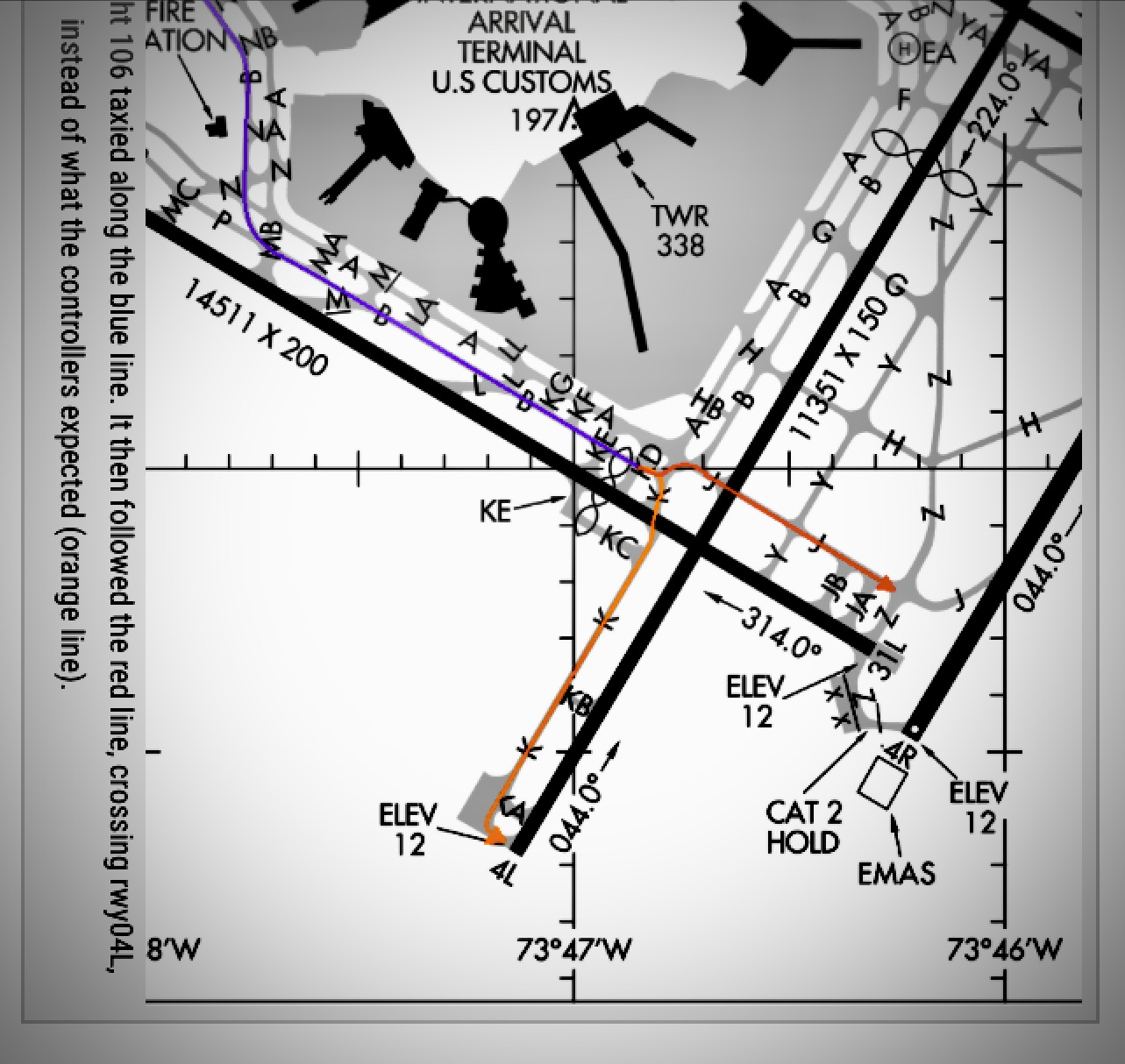 to do so. Instead, A/A 106 bore left, then right so as to head straight across 4L in front of Delta’s speeding 737, according to FAA officials. “Oh, shit,” screamed tower ATCs as they spotted A/A 106’s ‘possible pilot deviation’ (i.e., blunder), albeit with the assistance of a tracking system that detects/displays aircraft and ground vehicles on JFK taxi/runways. Thus controllers urgently ordered the 777 to ‘hold position’ on Taxiway Kilo, Delta to ‘cancel takeoff clearance’ on 4L.
Though nearly reaching V2 ‘rotation’, the 737 had just enough runway before it to ‘reject’ clearance by reversing thrust and braking, then aborting to a ‘safe stop’. As for A/A 106’s crew, who apparently thought they had heard and affirmed tower commands properly, were corrected and advised by controllers that they were in violation of FAA rules. Still the 777 was soon cleared to depart for London from Runway 4L almost as if nothing that hazardous had occurred, while Delta 1943 and its passengers needed to layover at JFK until morning, ostensibly due to staffing shortages.
So close, but no rites and flowers. Still, let investigations begin: The National Transportation Safety Board has already landed to take flight crew and Kennedy Tower ATC statements, pore over flight recorder data on this latest potential ‘runway incursion’. One hitch—the planes’ ‘black boxes’ only hold two hours of recordings, and American 106 logged seven hours to London, with much of the flight’s JFK data likely overwritten. Reason enough why NTSB officials have long been prodding the FAA to boost flight recorder capacity to 24 hours.
In any case, given this chilling episode, one can’t help but reflect upon what continues to be the most fatal of such runway incursions—all the way back to 1977: 
The Tragedy of Tenerife.
On March 27, two Boeing 747s collided on the runway of Tenerife’s Los Rodeos Airport in the Canary Islands. KLM Flight 4805, in takeoff mode, crashed into Pan Am Flight 1736, which happened to be on the same foggy runway—killing 583 passengers (KLM 248; Pan Am 335). As per this simulation ⇒
The Pan Am crew, suddenly spotting KLM’s landing lights racing toward them, attempted to veer their aircraft off the runway onto shoulder ground. Flight 4805, seeing 1736 far too late, tried in vain to lift off, but its landing gear clipped Pan Am’s fuselage and tail. Struggling to gain altitude, the KLM jet 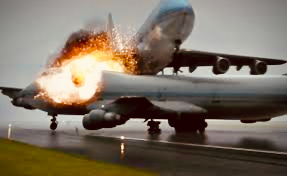 crashed into a fireball, its engines choking on 747 debris.
Subsequent investigations concluded that a bomb set off earlier (+ further threats) by some Canary Islands Independence Movement had forced the regional airport to close its four small taxiways, narrowing flight ground traffic capacity to that single runway. Contributing as well was the KLM captains’ mistaken belief that his flight had been cleared for takeoff—allegedly resulting from radio/language miscommunication between his crew and ATC, but KLM Airlines eventually took responsibility.
The Canary Islands crash remains the deadliest in aviation history. Then again, we’ve come a long way since those paleo-primitive days, right? Go ask the flight crew of a JetBlue plane off to Puerto Rico, which nicked a neighbor jet as JB taxied out from its JFK gate—just like it was yesterday. Because it was. (MTC…)
Close Encounters of the Dire Kind.
May 22, 2022—Up go the warning flares, but some say there’s not enough there there.
US flight safety regulators and industry watchers have recently noted an increase in midair collision (MC) warnings across the country, particularly near a number of busy airports. However the Federal Aviation Administration and airline executives see no ‘imminent risk’ of such inflight catastrophes on their radar  screens these days. And although the National Transportation Safety Board (NTSB) does report a climb in these airborne collision warnings near several key ‘hub’ airports nationwide, the numbers remain statistically infinitesimal with respect to the 6.2m domestic flights tracked in 2021.
More specifically, these ‘close-calls’ are defined as situations in which ‘pilots must take last-second evasive maneuvers’ to avoid impact with another aircraft. The FAA, which oversees flight safety/reviews overall, claims midair collisions have been predominantly eliminated, due to technological advances the likes of Traffic, Alert and Collision Avoidance Systems (TCAS) that generate automated warnings of nearby aircraft. Should the planes in question continue on a convergence course, TCAS automatically provides more urgent voice commands to either nose up or down, and pilots must respond accordingly, taking evasive action in less than one minute. Beyond the air traffic controllers (ATC) and airlines involved, FAA and NTSB regulators also keep tabs on these ‘resolution advisories’ as they arise.
Of particular concern are escalating instances near Minneapolis-St. Paul International and Hollywood-Burbank Airports, as well as pattern increases at Dallas-Ft. Worth, JFK, Miami International and Honolulu’s Inouye International. Airports throughout Florida are also being closely watched, what with the popular state’s frequent thunderstorms and other bad weather, not to mention a rapid increase in business and travel/tourism air traffic with ATC staffing problems, and Kennedy Space Center rocket launches, NASA and commercial.
Mile-high Denver doesn’t fare much better, especially during turbulent landing approaches to certain  troublesome DIA runways. Hence ‘nuisance alerts’ are often issued when onboard TCAS gets disoriented at altitude and falsely orders landing re-do’s—to where enhanced ATC allows pilots to effectively override/turn off TCAS under certain conditions, ostensibly to limit prolonged flight times.
These are but some of the red flags raised as the FAA and various aviation interests monitor and analyze this ‘tightening close-call trend’, given that air traffic continues returning to pre-pandemic density levels.  The problem lies in adequately collecting MC data: Airport operators have no comment, deferring to the greater federal authorities, and airline reporting is inconsistent, at best. Moreover, while separate track reporting of close-call hazards to the NTSB is mandatory, reporting of possible MC threats to the FAA is voluntary—meaning catch as catch canThus the bottom line: Serious as the dangers of midair collisions may be, current data is simply not sufficiently reliable to facilitate ‘definitive risk assessments’. Meanwhile the skies fill and spill over with jam-packed tubular projectiles…
In other words: close, but not so far…(MTC…)
The Latest FAA Fly-bye.
March 28, 2022—More regulatory air turbulence developed March 26 as Department of Transportation Secretary, Pete Buttigieg announced a temporary regime change at the Federal Aviation Administration. This at a time when the agency is flagged for being too lax with SWA on earlier issues of the carrier’s investigation/documentation stalling, and flying a number of used airplanes not adequately inspected and repaired .
On March 31, current administrator Steven Dickson will step down merely halfway through his 5-year appointment, and associate admin, William Nolen will take the FAA helm, albeit in an (18.5) acting role until the agency’s next (19th) permanent head is found, nominated and Senate confirmed.
Dickson says bye-bye, in favor of more ‘family time’, as perhaps the most chastened FAA administrator since (5th ) Nixon-appointee, Alexander Butterfield abruptly resigned March 21, 1975, some two years in, after unwittingly revealing that the infamous White House tapes existed before a Watergate-investigating senate hearing. Because Trump’s choice, Dickson manned the FAA yoke (replacing ineffectual acting head, Daniel Elwell) during much of the 737 MAX debacle:in which the agency was found to have all but ceded its aviation safety oversight function to Boeing in-house managers prior to the deadly Lion Air and Ethiopian Airways disasters.
To his credit, Dickson has been tightening FAA screws of late, but the agency-Boeing regulatory relationship remains under heightened legislative and media scrutiny.
In any case, Dickson’s replacement pro tem, Bill Nolen is a former military and airline pilot turned aircraft industry safety executive who has been overseeing 7,600 FAA employees as Associate Administrator for  Aviation Safety since this past January. Earlier in his career, he flew Boing 757, 767 and MD-80 jets for American Airlines—and had since been an air carrier safety and security administrator for Qantas, WestJet (VP), then a senior vice president with the Airlines for America trade group.
Joining Nolen is Deputy Administrator Bradley Mims in an expanded role, to form an extensively experienced ‘Billy and Brad’ team, according to Transportation Secretary Buttigieg—one that ostensibly will provide sure, stable leadership in today’s increasingly stormy skies.
We’ll see how fleeting this latest interim FAA fly-by may prove to be, however, given the complexities of post-pandemic airline recovery, of infrastructure issues ranging from airport expansion to implementing new green and/or navigational technologies. Next man/woman up? (MTC…)
Scrambled Drill.
January 11, 2022—Missile gaping at North Korea’s latest ‘hypersonic’ launch, the FAA ordered a sudden “ground stop” Monday for 15 muddled minutes.
The Jong-un-timely alert halted landings at many West Coast airports from Oregon to San Diego, resulting in a flurry of scrambled ‘whattup?’ exchanges between air traffic control towers and airborne pilots. 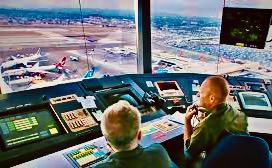
Transportation Secretary Pete Buttigieg quickly defended the FAA’s precautionary action, saying the agency’s bottom line is maintaining safe aviation operations, and “…(it) will err on the side of caution…at all times.”
But the North American Aerospace Defense Command (NORAD), which monitors US and Canadian airspace, claims it did not issue such a “ground stop” warning to the FAA, and that the Jajang province launch was no threat to North America anyway, as the missile ultimately landed in waters between Japan and the Korean Peninsula.
The FAA said it is reviewing the episode, and neither it nor the D.O.T. would drill down any further.
Apparently, hyper-caution is as hypersonic does: it’s a routine matter of procedure. So looks like we can only hyperventilate in relief. (MTC…)
Riding the Gravy Train?
February 8, 2021—Has the Department of Transportation cabinet post become a loyal patronage plum, just another party favor?
No sooner are we bidding ciao to one politically looped Transportation Secretary than ‘Mayor Pete’ is Senate confirmed as Elaine Chao’s (as in Mrs. Moscowl Mitch’s) successor. President Joe Biden had tendered Peter Buttigieg as his choice for this key cabinet position—a token of his esteem, glowing over his former campaign rival as though the young Hoosier were a natural-born son.
All well and good—just double-check the boxes: new administration, honeymoon period, diversity, exciting new  next-gen blood. Buttigieg is a former mayor, vanity presidential candidate, Rhodes Scholar, Naval Reserve intel/Afghan vet, gay ceiling buster, reputed policy wonk with a big heart and ramrod spine. He is fully on board with anti-inequality, racial/minority balance, environmental impact—so what’s not to like?
Really, in his brief acceptance presser, the 39-year-old cited his mayoral tenure in South Bend, Indiana—how the regional Midwestern city straddles a bend in the brimming St. Joseph river, that a rail route runs through town, how he observed so much of the country during his (aborted) White House run. Indeed, he actually proposed marriage to his husband at Chicago’s O’Hare International Airport.
Diversity Over Curricula Vitae?
With all due respect, his rubber-to-road transportation credentials are somewhat akin to Sarah Palin’s geo-worldly “I can see Russia from my (kitchen) window” bona fides. For what heavyweight airways/ rail/vehicle issues, which major transportation/traffic challenges, or macro policy, logistical, technical hurdles did Mayor Pete face in South Bend beyond redirecting downtown traffic and installing bike lanes?
Arguably Biden could have chosen a heftier candidate for the DOT position: other potential candidates who would have brought far more experience and expertise to the vital transportation job. Namely where are the likes of such past Transprepared, Washington savvy Secretaries as Brock Adams, Norman Mineta and Ray LaHood—not to mention eminent former NTSB Chairman, Jim Burnet? Accordingly, what Buttigieg lacks in stature for this challenging cabinet post, he must bring in an abundance of stamina.
Symbolism Over Seasoning?
Point being Mayor Pete will face a steep learning curve and pressurized OJT in managing the department’s nearly $90b budget and 55,000 employees (½ the population of South Bend). Pivotal issues in the transportation/infrastructure sectors (aerospace, rail, highway)—all decimated during the COVID-19 pandemic—must be addressed full throttle. Moreover, from mask mandates to righting a tailspun FAA (re: safety, regulatory oversight ‘to the max’) and TSA, to rebuilding collapsing bridges, plenty of other problems loom just around the bend.
Surely green, climate-centric issues such as net-zero emissions, hybrid/electric vehicles (autos, SUVs) and other environmental redress are rightfully atop the Biden agenda. On that score, Buttigieg has testified that climate change is his top priority, reducing carbon and greenhouse gas emissions by re-raising fuel economy standards and accelerating the transition from gas to electric powered vehicles via some 500k new charging stations nationwide.
But so must be greenback matters confronting the travel/tourism space battered by pandemic restrictions. Transportation networks—ailing airlines to trains to trucking—come top of mind, particularly funding  (budgetary and via competitive grants) for strapped metro transit authorities (light rail, bus, subway), so long as people stay and work from home, ditching travel altogether.
This includes further implementing hi-tech traffic/safety advances, repairing tireworn, potholed roadways, dealing with Highway Trust Fund shortfalls vs. federal gas tax increases. In his Senate hearing, Buttigieg declared his allegiance to President “Amtrak Joe” Biden’s $2t infrastructure plan (w/$20b for public transit), assisting states and cities with road and bridge revamping, somewhat via BUILD grants. Yet he is already wavering over whether to raise those gasoline taxes (based on miles driven?!) to pave the way for Highway Fund reformation, as well as extending Airline payroll relief. Moreover, along with restoring automotive emission standards, Biden’s DOT will be charged and challenged with overseeing technological developments such as self-driving cars—while striving to make railway as well as racial inroads.
Substance Over Showtime?
There’s so much to be done in the area of federal transportation policy, particularly given these past years of Republican resistance. But at least the DOT will not be administered by an ongoing Elaine Chao regime hell bent on impassively tearing the department down. Namely it jettisoned consumer complaints, schemed to cut regulations and privatize essential government functions such as air traffic control. Hence misusive Empress Chao’s crew neither attempted nor accomplished much of genuine merit, even though she initially did bring a measure of inside DOT experience to the Secretary post.
Thus it is incumbent upon President Biden’s neophyte cabinet member to buckle up, drill down and wonk this way. Time for the Rhodes Scholar to become a roads scholar forthwith, if Buttigieg is to handily take the department’s helm. Mayor Pete will need to gain critical OJT, earn some speedy air, rail and street cred, despite packing along little or no time-tested experience in the rutty ways and means of Washington D.C.—especially since Congress, which controls funding formulas, is already bickering over how to pay for this all.
Reason enough to be plumb wary of Biden’s choice for the crucial DOT position at this critical time. Not least when some political observers are calling the job a whistle stop on Buttigieg’s fast-track to higher office. While other pundits dismiss the “low-profile” transportation post as little more than a presidential stepping stone. Problem is, stepping stones are often whereon such highball ambitious types slip and fall.
So Vamigré will rigorously semaphore moves and motives from the fresh-faced secretary, as well as his relatively more traveled underlings, with the hope that Mayor Pete’s training wheels don’t go flying off as the transportation sector comes rolling back to life. (MTC…)
Unrest, Rifling and Insurrection.
January 15, 2021—Amid the debris of the January 6, 2021 D.C. riot and insurgency comes a January 14 FAA order declaring zero tolerance of misbehavior on US airliners or in airports. Citing safety and security concerns, the aviation agency was clearly responding to reports of chaos and coercion in the Congressional protest mobilization’s not-so-friendly skies.
Carrier ground staffers and flight crews alike have complained of an unruly mob mentality carried on aboard, more often than not by maskless ‘Trump Army’ supporters that manifested in brazen squabbles, abusive threats, criminal intimidation and physical violence at boarding gates on up to 30,000 feet.
So hereafter the FAA ruling bans any such terminal and/or airborne belligerence, vandalism and all manner of disruption, setting a potential $35,000 fine, jail time and TSA no-fly listing for the line-crossing beefers, badgers, browbeaters and other badasses among us. In other words, if you’re looking to raise some hell, best to raise the bar. Vamigré says bully for that. But as for the prospect of an increased onboard presence of sky marshals, of covert TSA and FBI agents, warrants a wait and see attitude…
January 16, 2021—That FAA measure coincides with the rise of tourist/traveler rascality in destinations worldwide. Most recently, a penitent young woman from Atlanta returned a block of marble she apparently had lifted from Italy’s Roman Forum. The site museum’s director said that ancient fragment was accompanied by a mea culpa note begging forgiveness for her having been “inconsiderate and disrespectful.” Problem is the stone had been defaced with a magic-marker inscription the sorry tourist had spontaneously written to a friend, and she could neither rub nor scrub away. Thankfully the artifact is now back in expert restorative hands.
Seems the guilt-ridden woman may have been inspired by news that a Canadian woman had earlier sent back two mosaic tiles and section from a ceramic amphora she had pilfered from the ancient city of Pompeii in 2005. In her letter, she confessed her belief that the long-buried remains from the Mount Vesuvius volcano had cursed her with the misfortune of two breast cancer sieges…
Karma, shmarma, Vamigrés—what say we keep our hands on our personal valuables, settle for taking harmless elsies™ and selfies? Otherwise leaving be what is historically, culturally there for all to see…
Just sayin’ + see: Malpractices & Malfeasance for another take altogether…
Farewell DOT And Dash.
Update: Decemeber 6, 2020—Perhaps a last-gasp Department of Transportation (DOT) move by the rump Trump Administration: This late Friday afternoon gift was quietly delivered to the struggling airline industry after ‘supersonic’ lobbying by the Airlines For America trade group.
The regulation, coming one day after Thanksgiving, was couched as traveler friendly, purporting to ‘streamline’ the filing of consumer complaints with the DOT by “…providing more clarity on unfair and deceptive practices in aviation consumer protection.” The directive is said to benefit the public and regulated entities through greater transparency and predictability, affording widespread and lasting benefits to the airlines, air travelers and economy.
But in essence the rule narrowly redefines unfair deceptive practices (not ‘well-defined’ in the past) more favorably to airlines than to air travel consumers. How so? By setting up roadblocks to consumer complaints, narrowing its own ability to protect the traveling public, and making it more difficult to enact future transportation department consumer protections.
This DOT bunch has already proven to be toothless, seldomly acting on consumer complaints, particularly regarding airlines’ refusing to pay refunds for cancelled flights during the pandemic. The department has otherwise been offering only weak warnings, but not a single enforcement action, despite record numbers of passenger complaints.
Bottom line: we airline passengers are now left all the more vulnerable to flight delays/cancellations and misleading information on fares and fees, with even less governmental recourse.
Therefore this rule change appears to be little more than another Trumpian fare-thee-well on the regime’s way down its evacuation slides. Hopefully the new administration will reverse thrusters on this afterburning DOT order in short order. Or Vamigré will have to see that it does. (MTC…)
In theory, the Federal government is charged with overseeing and regulating key transportation functions.
Yet so many contentious issues arise. And where to turn in the face of governmental failings and shortfalls—where departments seem reluctant to regulate the transportation industries for which they are so authorized? ☟☟
Whom do we see when the T.S.A. security/inspection regimen is clouded with turnover, inconsistency, aggression and overreach, much less being rife with vendor kickbacks and conflicted double-dealing? ☟
What do we do about the Congressional plan to cut essential air service subsidies to less trafficked, more remote destinations and locales? How will this impact the Vamigré standard of Destination Dispersion?
How can we pressure the National Transportation Safety Board (NTSB) to speed up its crash/accident investigations—long at a snail’s pace to resolving cause and finding evidential responsibility amid the diverging, adversarial interests of carriers, insurance firms, plane manufacturers and victim survivors? Clearly, the NTSB fact-finding verdicts need not drag on for months and years after the tragedy itself—so that critical remedies and improvements can more safely and speedily remedied and adjusted. Not least the improvement on and modernization of runway (anti-collision) safety systems.
Why must it take a Court of Appeals order (or Congress) to force the FAA to address minimum cabin seat size standards, among far too many air travel issues of safety, health, convenience, cushioned scheduling and customer mistreatment?
Take, for example, the agency’s recent treatment of troubled Allegiant Air. Is it patrolling or pledging allegiance to a carrier that is accused of operating an aging, unsafe fleet of MD-80s, logging at least 100 mechanical incidents or Service Difficulty Reports over the past three years, with no enforcement actions? Is the FAA working to correct these infractions so as to ensure public/passenger safety, or passively coddling a fast-and-loose airline to preserve its strained business model and physical assets?
Further, what should we make of the Trump Administration’s persistence on the Republican-led Congress’s perennial effort to privatize (and pull the FAA’s plug) on administering air traffic control in airports nationwide?
Not least come the revelations of trouble/turmoil in the TSA’s Air Marshals Program. Rumors and a Government Accountability Office report cite widespread burnout, low morale, health problems and alcohol abuse among officers charged with protecting the in-terminal and onboard traveling public from threatening disturbances and terrorist attacks. Interviews and court documents detail harassment and discrimination throughout the air marshal ranks, managerial misconduct (including hookers and losing weapons) on down. Such turmoil does prompt the question of whether air marshals do effectively protect us travelers, or if the entire program is just more futile security theater.
These and other infrastructure matters will also be Vamigré’s bailiwick and domain, in our truest traveler interest—safety, responsiveness, efficacy and efficiency in mind, above all…
☟☟
DOT: Fed Follies and Fallacies.
You’re sitting there belted in, wondering if the tight seating and narrow rows would enable you to evacuate the plane safely should an emergency arise. The flight crew is concerned  that they lack a second barrier door the thwart attackers when the pilots open their cockpit door to, say, use the bathroom. Everybody aboard has apprehension over whether the flight’s vast array of lithium-ion batteries are being safely utilized and/or stored.
Tell you who’s not overly stressed about such pressing issues: the U.S. Department of Transportation. Oh, DOT is well versed on legislation Congress passed in 2016 (and amended in 2018) to address an array of air safety concerns. The department claims it is committed to complying with the law’s requirements as an implementation deadline passes one year after the fact, but that enacting the legislation’s 360 rules “takes time.”
However DOT’s ‘hit and miss’ approach to these air travel matters is wearing thin up on Capitol Hill, where the House Aviation Subcommittee is running out of patience, as is Vamigré.
For one thing, the department has determined that the airlines’ practice of squeezing a 31-inch seat row width down to 28 inches or so will not negatively impact an aircraft’s quick, easy evacuation in emergency situations. But even the FAA begs to differ on that and minimum seat size, so is planning to conduct further evac testing this November.
Beyond seat dimensions and onboard hazards (including how/when to deny boarding to fairly jettison  troublemakers from aircraft), DOT is expected to take up baggage fee refunds when checked luggage is not promptly returned, and additional fees if airlines don’t deliver on promised services. Rule revisions on disabled passenger rights, family together seating and cell phone call restrictions have yet to be fully vetted. As to the crew side, flight attendant seek an increase in rest between workdays from eight to ten hours—to align with pilots’ down time.
Yet the department under Secretary Elaine Chao has consistently appeared averse to such regulation, preferring to let market forces remedy ‘bad airline industry decisions’. As for travel consumer protections, DOT has slow-walked on hiring a 2018 Congressionally mandated consumer advocate, and inspecting airline compliance on customer service policies, much less addressing consumer complaints (regarding flight cancellations, tarmac delays, etc.).
Currently, the department foresees meeting the Congressional legislation’s many and varied stipulations by year’s end—more like early 2020—with rule-making to include tech specs and specific cost/benefit analyses. We’ll grandstand to see if the DOT is still doting, playing with House money between now and then—bet on it…
☟
F.A.A. Head Fake.
 As for the FAA itself, while the agency wrestles with the MAX/MCAS fallout and myriad other aviation tumult, President Trump tenders his choice for settled agency leadership.
To review: the FAA has been without a permanent head since Michael Huerta ended his four-year terms in January, 2018. Since then, former American Airlines pilot and deputy agency administrator, Daniel Elwell has been acting leader—or inacting, as the case may be.
After Trump’s first pick for the full role—his personal pilot no less, was shot down like a rogue drone—the president named an ex-Delta pilot and flight ops executive “with complete confidence (he will) be confirmed”.
Long-Winded Resistance.
But not if the Senate Commerce Committee can (or cannot) help it.
Mainly Senate Democrats (and certain Republicans) consider nominee Stephan Dickson unfit for the job. They note post-737 MAX air safety concerns andDickson’s 27-year ties to the airline industry. Then came a $1m whistleblower suit brought by Delta pilot, Karlene Petitt claiming that Dickson was involved in retaliating against her for complaining of overworked pilots, unsafe working conditions and inadequate training.
The airline’s response was to ban her from flying out to a Delta investigator’s and psychiatrist’s finding the Petitt had a bipolar disorder. Dickson neglected to mention all this in his FAA head application.
Democrat Richard Blumenthal has found that omission “potentially disqualifying”. Dickson counters that he had “not previously and will never tolerate retaliation of any kind to any employee who raises safety concerns. I fully understand the importance of safety being the top priority of the FAA”. He adds that the (Petitt bipolar) “referral was a sound course of action…based on a credible report about statements the pilot made to company officials and behavior she exhibited, which raised legitimate questions about her fitness to fly”. Dickson explains that he did not mention the case as part of his FAA application because he was not named in the suit.
Still, it looks like his nomination could descend into just one more partisan battleground, safety oversight concerns notwithstanding.
For his part, former head Huerta said “it is important that the FAA be a nonpartisan organization—that everyone wants aviation safety”.
Nevertheless, Senate Democrats had already sounded alarms over the agency’s slow response to the 737 MAX grounding and certification process to Elwell and Transportation Secretary Elaine Chao.
What with more MAX-related Congressional hearings on the upcoming docket, it remains to be seen whether Dickson’s nomination will fly (he has since been confirmed by the U.S. Senate). Still, Vamigré will keep a falcon’s eye on all that…