


Previous Story
Doggone Dilemma.📌
Posted On 02 Feb 2019
Comment: 0
Target: Malfeasance, Malfeesance (Premise)
Pupdate: 9/5/2021—Seems that the whole onboard animal support issue has gone to the dogs. For the U.S. Department of Transportation (DOT) has recently ruled that pigs, pythons, peacocks and other such species have no place in airliner cabins anymore. Meaning that hereafter, emotional support animals (ESAs) will be considered discretionary pets rather than prescribed therapy, and that airlines can now further limit service animals not just to common dogs, but to certifiably trained canines.
The DOT’s final rule on Traveling by Air with Service Animals defines a service animal as “a dog, regardless of breed or type, that is individually trained to do work or perform tasks for the benefit of a qualified individual with a disability, including a physical, sensory, psychiatric, intellectual, or other mental disability.” By contrast, mental health professionals normally prescribe ESA’s (not necessarily dogs nor trained in specific tasks) simply to afford their owners comfort and support.
The determination came in the wake of airline and disgruntled consumer complaints that too many passengers were passing off their pet whatever as a fee-free emotional support animal to avoid paying the typical small pet and cage/carrier charge of $125 per direction. Other gripes have centered on the disruptions and behavioral problems of an in-cabin ESA menagerie.
The Airlines For America trade group hailed DOT’s action, “…improving accessibility for passengers with disabilities and ensuring their safe travel” by protecting them from untrained animals in confined aircraft cabins. Airlines themselves have thanked the agency profusely for tossing them this contentious bone, as a route to better accommodating “…customers with legitimate service animals.”
Now carriers will be able to require passengers with service animals to complete and submit a DOT form that attests “…to the animal’s training and good behavior, and certifying the animal’s good health.”
Whereas passengers previously traveling with an ESA simply had to present a letter from a licensed health professional. Those travelers facing mental health challenges call this latest DOT ruling “a great disservice”, and express apprehension at flying without such creature comfort and companionship.
The ruling is scheduled to go into effect 30 days after being published in the Federal Register, but that publication date has yet to be set. In the meantime, expect a planeload of traveler barking, howling and growling to ensue. (MTC…)
May, 2019–Owing to the airlines’ byzantine shell games, we must resort to stuffing carry-on belongings onboard any how or where we can these days, to lessen the fee-lty burden. Which has resulted, not least, in the contortions and discomfit of in-cabin pets and/or ‘comfort’ animals. 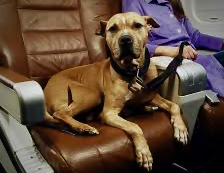
Be they dogs, cats, piglets or peacocks, with the occasional python and anaconda: the sheer number of companimals and support species has skyrocketed lately, despite travelers in many cases paying a premium to bring them aboard. Now, beyond tarmac strains and inflight mayhem, rights are rights, however wrong they may seem to fellow passengers in such confined quarters. But the air carriers’ loose-ship cabin ‘co-travel’ policies are increasingly precipitating sketchy, if not drastic measures to address the proliferation of service, emotional support animals, or just plain household and barnyard pets.
Most recently came the tragic death of a small dog stored in a United overhead bin on a Houston-to-New York run. Although the AFA-CWA union maintains that a flight attendant was not aware she was directing the placement of a live animal in the upper compartment, the incident boggles that its owner felt moved to so stow the dog at all. Moreover, United’s miscarriage of checked baggage in the cargo hold subsequently led to three dogs being wrongly routed, one to Tokyo instead of the intended Kansas City, Missouri. No real surprise here, since United allows more pets on its planes than any other airline, and has incurred the most pet fatalities, particularly in 2017—snub nosed dogs being especially at risk.
Add to this, onboard dog bites, flea infestation, and an array of animal misbehavior, clearly some rethinking and remedial action must be taken, not simply air carriers issuing rote apologies after the fact. United Air states that it will review its PetSafe program, and soon begin attaching distinctive yellow tags to passengers with pets; Delta says it will tighten behavior policies and require more health data on animals brought aboard. But tighter restrictions, long overdue, are likely cosmetic measures at best—especially since the Transportation Department is MIA on this issue thus far. 
So, taking a step further: Should we go forward to the past? For instance, harking back to the old railroad practice of designating smokers’ cars. Now if it is patently unrealistic to schedule exclusive commercial airline ‘Animals On Board’ flights (save for specific ’boutique’ carriers such as Pet Flights and Pet Express, etc.), perhaps aft-cabin passengers + pets sections are in order. They could be bulkheaded off, boarded first, deplaned last—whereby animal-free travelers could avoid annoying disruptions, transmittable diseases, cat-scratch fever, snake venom or the literal hair o’ the dog. Just sayin’…
Equally key, however, is divining passengers with legitimate, documented service or support animals from the furry flurry of pet crocks and zoo charades, for more in-flight peace of mind up and down the aisles.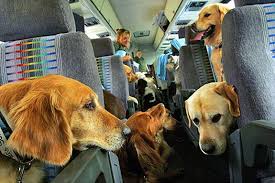
Otherwise, Vamigré will keep track of airline animal miscarriages and misdirections, of fellow passenger angst and abuses alike. Fixing on solutions (short of offing the programs altogether), quelling the casualties, monitoring and mediating future pets-on-planes debates: Never again having to hear ‘Stews, where’s our cat?’ Much less, ‘Dudes, where’s my cur?!’
UPDATE: UNITED WE STRAND.
UAL has since decided that, starting in July, the airline will no longer allow snub nosed or strong jawed dog breeds in its cabins or cargo holds. Moreover, United and Delta now seek to separate trained service dogs from passive emotional support types. The carriers urge tighter D.O.T. rules for certification and documented training for the latter, in the face of unwanted lickings, bitings, growling and blocking of aisles. Worse, they claim, animals have been spraying and crapping the cabins. Passengers and mental health advocates may complain that support pets are needed to get fearful, anxious flyers through stressful flights. But it looks like any animal besides trained and certified dogs (and certain cats) may soon be grounded from the airlines’ friendly skies—essentially meaning, no zoo for you…
Update: Here’s the scoop, or lack thereof: As of December 18, Delta Airlines is banning emotional support animals in flights lasting over eight hours, animals/pets under four years of age altogether, citing an 84% increase in biting incidents and sanitation problems in 2016-17. United has followed suit, now only allowing dogs and cats over 4 months old as ESA’s on flights no more than 8 hours long—emotional rescues notwithstanding, we can’t always get what we want…
Vamigré will keep tabs on this as D.O.T. decisions and rules changes are up for implentation…
PS: The service dogs are winning, if not the pet snakes and swine…
Upperdate (January, 2020): The U.S. Department of Transportation plans to tighten  the choke chain on air passengers’ carry-aboard animals.
D.O.T. wants to draw markedly more than a wee yellow line between fully trained, certified service animals, and the traveling zoo of creatures passengers are unleashing on airplane cabins in the name of flying comfort and companionship.
Especially since airlines were stampeded by over 3,000 service animal complaints in 2018 alone—primarily over fights, bites, seat transgressions and a wild array of unspeakable messes.
The department clearly focuses on the catch-all category of ‘support animals’ which, along with the designated service classification, have been allowed to fly free, rather than incurring “pet” fees of $125 and upward.
So paying ‘pets’ these emotional support animals would be (poodles to pythons), unless they are professionally trained service dogs accompanying and aiding passengers with documented disabilities and/or disorders.
Further, such designated travelers would be required to verify their animals’ credentials pre-boarding, and keep them adequately harassed and leashed. A cap would also be placed on the number of service animals per passenger.
Travelers will now have a 60-day comment period to rein in our onboard barnyard, or otherwise muzzle the D.O.T. and bring it to heel. (MTC…)