
Drone and Groan. 📌
Further Disruption in the air: One of Europe’s busiest, if not notorious airports has essentially been grounded by one or two mischievous little drones, a humiliating, paralyzing ordeal that has lasted more than 36 hours so far.
The device(s) were first spotted buzzing over Gatwick’s perimeter and runway area on Wednesday evening, and London’s number two airport was shut down at 2100 hours. Sadly, on the 30th anniversary of Pan Am 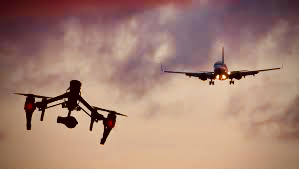 103’s Lockerbie disaster, officials had already stopped all takeoffs and landings until the facility’s runway was deemed safe to reopen. Hazard cited: a drone colliding with an airliner during those crucial takeoff or landing procedures, if not getting drawn into jet engines and exploding in a spray of metal, plastic and lithium batteries—as if bird sucking weren’t bad enough.
Flights were either cancelled or diverted all over Europe, as far away as Paris. Holiday plans were scuttled, tens of thousands of passengers left clueless and stranded in overcrowded terminals or stuck on planes, scrambling and searching for updates, wondering why the airlines weren’t more informationally forthcoming (as usual), or airport security and emergency systems weren’t more responsive.
Drone Strife.
All this over the spotting of two, then a single drone flitting about overhead. Airport staffers were quick to state that this was not a terrorism act, nor merely harmless toys. But they were unable to clearly identify or size up the airborne device(s)—simply labeling them ‘industrial specification’ drones. Disabling these pests was even more problematic, as sharpshooting down the appearing/disappearing, bobbing and weaving objects, spraying stray bullets in the process, was safely out of the question.
By Thursday, 760 flights in and out of Gatwick were delayed or cancelled, some 110,000 passengers had been affected, many reduced to floor sleeping amid south terminal bedlam. Military units joined a growing police presence, shootdowns were reconsidered as a ‘tactical option’ and dumbfounded officials scrambled for emergency alternatives, PM Theresa May included. Still, at least one drone continued to buzz Britain’s second largest airport, which normally serves as a trans-Atlantic gateway for British Air, Delta and Virgin, as well as intra-Euro budget carriers like RyanAir, Norwegian Air and EasyJet.
Come Friday, cancelled flights totaled 800, stalled passengers 120,000, and Gatwick powers continued  playing cat-and-mouse as the now 36-hour disruption droned on. But citing ‘mitigating measures’ (including detection and tracking equipment), officials watchfully reopened the airport’s lone runway, and backed-up holiday traffic began flowing again, bracing for more than 2.9 million passengers over the Christmas/New Years period. Yet another afternoon drone incursion brought a brief hiccup to all that, the operators remaining at large.
But while passengers fear even more such incidents, airlines grounded at Gatwick are already claiming ‘extraordinary circumstances’ to avoid compensating their paying paying customers for all the upheaval and inconvenience. At a minimum, affected travelers are entitled to meals, refreshments, hotels and transfers, but good luck being fairly reimbursed for any of it—instead getting beaten down once again.
Debugging an Aerial Infestation.
Official consensus among British authorities is that ‘we cannot let drones close a vital part of national infrastructure this way’. This is surely no one-off however, with copy-cats (hobbyists to jihadi bombers) firing up their devices the world over in the wake of such operational impotence and high-profile media coverage. Moreover, Gatwick is not alone in being shown as vulnerable to drone hi-jinx; over 90% of the world’s airports are said to be unprepared for the pesky disruption, as commercial and recreational drone use grows exponentially, and the devices are designed smaller, faster and cheaper than ever.
UK law holds that it is illegal to fly a drone or similar device within 1 km of an airport or airfield perimeter, and above 400 feet, or within 50m of people, vehicles and buildings. But enforcement has been spotty and well behind the curve. So Great Britain has already reported over 100 unsolved drone/aircraft scares in the past year. For its part, the U.S. FAA tracks over 1,000 suspected near misses between planes and unmanned aircraft per annum, and already requires physical ID markers and registration for drones over a minimal size and weight. While Mexican authorities probe a possible collision between a drone and Aeromexico flight just last week, the 737 landing safely, but showing significant damage to its nose. 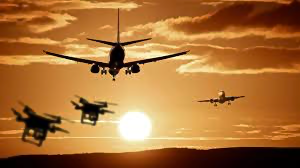
To tackle this surge in drone sightings and close-call incidents, a fledgling defense industry is currently developing technologies ranging from electronic fences that detect, jam radio transmissions, all the way to a ‘drone hunter’ radar system to spot intruder drones and dog-fight them out of the sky. But these ‘solutions’ are playing catch-up and whack-a-mole at best, and far from standardized. While the drone industry presses government officials to open up more radio frequency bandwidth before adequate tracking safeguards and virtual device registration are firmly established.
In the meantime, Gatwick’s chief executive says patrols have been increased, adding that, “This (drone) is obviously a relatively new technology…and we need to think through together the right solutions to make sure it cannot happen again.”
Saturday brought a steady resumption of airport traffic, albeit under threat of dronal encores (40-50 sightings there so far). Along those lines, Sussex Police took a local couple into custody for questioning Friday evening in the Gatwick drone caper. Could they be environmental activists, for instance, protesting runway expansion proposals? If charged and convicted, the as yet unidentified suspects face five years in prison for “disrupting civil aviation to endanger or likely to endanger safety of operations or persons.”
Vamigré will see if that charge flies (turns out the couple has been cleared, while a damaged drone has been discovered nearby). Even snipers and trained eagles are among resources since added to catch the remote controlling culprit(s), as yet to no avail. With no Gatwick suspects in sight, British authorities have otherwise established a 5 km ‘no-drone zone’ around the nation’s airports for added air safety going forward. Still, another possible zone sighting, this one at Heathrow this past Tuesday evening, grounded all flights for more than an hour—again with no suspects to be found.
So we’ll otherwise follow overflight progress as beleaguered Gatwick offers a £50,000 reward for information on the drone incursions, struggles to swat its flies, work out the bugs. That is, return to its woefully normal airport operation.
Droning On…
The FAA’s latest proposals seek to loosen drone restrictions. Essentially, the agency plans to establish three categories, by weight and potential damage causation: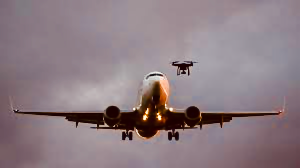
- The smallest drones, lighter than 0.55 pounds, would be allowed to fly over people, if the operator maintains line of sight, and remains below 400-foot altitude. These could also be flown by trained pilots at night, if outfitted with anti-collision lighting.
- Group two would require rotary blade shields.
- The larger category would be prohibited from hovering over individuals or groups of people—and required to notify people if flying over restricted access sites.
- In addition, all but the tiniest civilian drones will have to regularly broadcast tracking data by radio, according to draft rules recently proffered by FAA regulators. The goal is
 greater air safety and security in the face of burgeoning drone-driven commerce and recreational usage—not unlike the current air traffic control network for commercial aircraft. Backed by homeland security and law enforcement agencies, this controversial ‘unmanned traffic management ecosystem’ would be implemented within three years of final approval. But there is likely to be an ‘airswell’ of debate and opposition (by industries and hobbyists alike) before such a massive new network could take flight.
Otherwise, earlier U.S. restrictions would pertain, including minimum distances from designated airport/spaces, and that all drones must be registered with the FAA–which also recently issued a warning notice against ‘weaponizing’ any drones with guns, bombs, missiles, flamethrowers, fireworks and whatever else that “…may be used for, or is readily capable of, causing death or serious bodily injury.” To say the least….
The latest proposals will now be subject to public/industry input, and wouldn’t be enacted until 2020 at the earliest.
Vamigré will hover over all of the above as any of it takes flight…
Case in point, the two drones spotted near New Jersey’s (private) Teterboro Airport Tuesday, one coming within 30 feet of a general aircraft–close enough to where Newark International, 11th busiest in U.S., briefly shut down as a precaution…


